
Boulder City Council April 16th Meeting


Public Hearing: Metro Districts Framework (Ordinance 8748 & Resolution 1378)
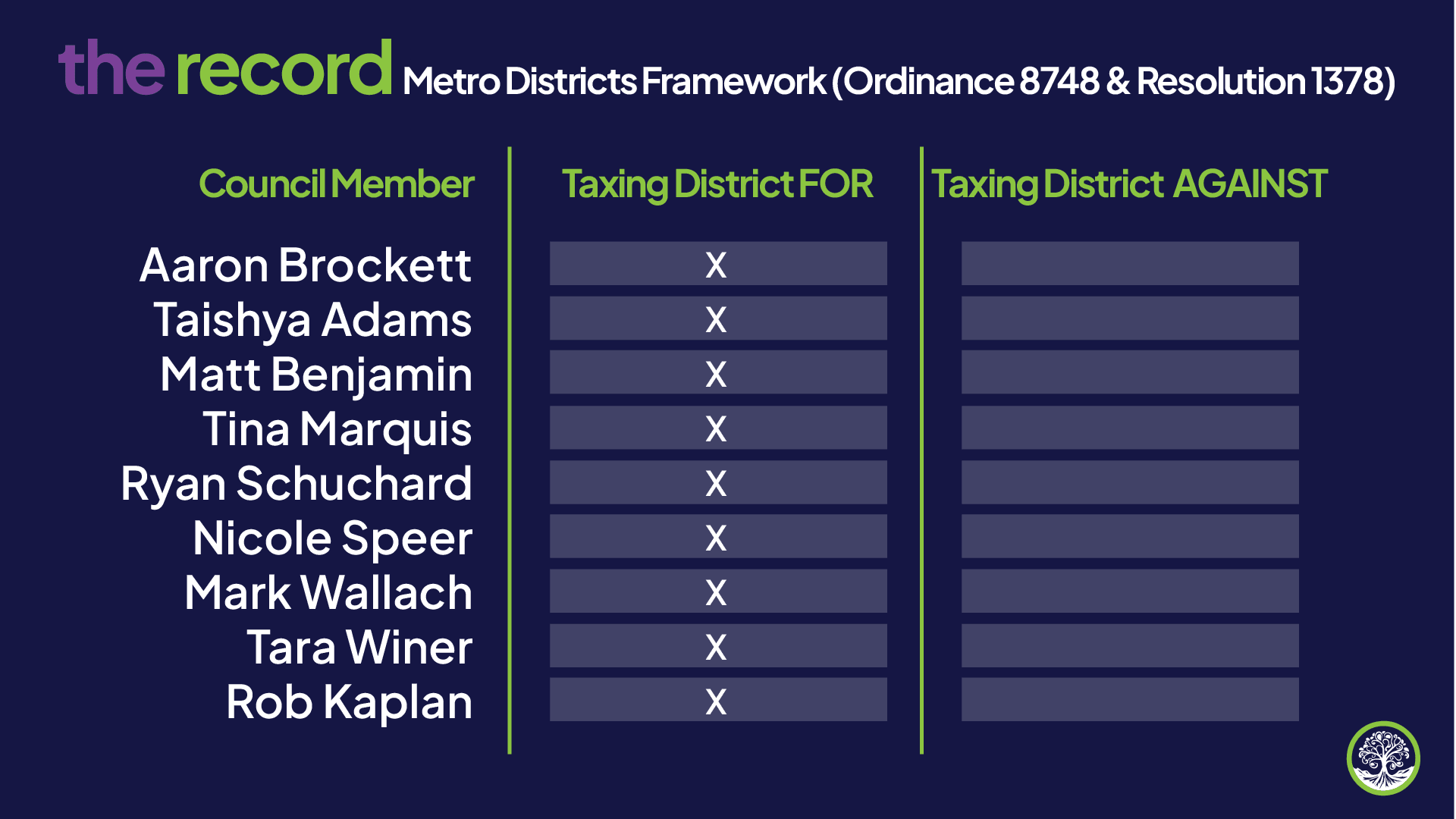
Date of vote: 4/16/2026
Outcome: Unanimously Approved
Category: Taxing District
What Happened
City Council held a public hearing and approved a new local framework to allow and regulate metro districts in Boulder.
This included: Adoption of Ordinance 8748, establishing Boulder’s authority over metro districts and adoption of Resolution 1378, creating a model service plan for how they will operate.
The goal is to shift metro districts from the default state-controlled process to a city-controlled process, giving Boulder more oversight over how and when they are used.
Per the meeting presentation, a few key elements of the framework:
- Metro districts in Boulder will be primarily commercial (90%+), not residential-focused
- Council must approve every service plan before a district is formed
- The city will oversee the full lifecycle, including formation, financing, and major changes
- These districts are intended to finance large-scale infrastructure upfront, with repayment through property taxes from the people who live and work in the district over time
Council discussion focused heavily on governance, financial risk, and how these districts evolve over time. One notable concern raised is that metro districts are often initially controlled by one or two property owners (typically developers), who also elect the first board and over time, governance shifts as residents and tenants move in, but according to staff, conflicts during that transition are common.
What It Means
This is a big shift in how Boulder could fund future development.
Metro districts are one of several financing tools alongside Tax Increment Financing (TIF- borrowing against future generated tax dollars the projects are expected to generate), General Improvement District (GID- lets a defined group of properties pay an extra tax to fund things like streets, landscaping, or parking that benefit their area).
Metro districts are unique because they allow developers to fund infrastructure upfront and repay costs through a dedicated property tax (mill levy) over time. Boulder has approved a max of 65 mills. As a simple example, at $1 mill per $1000, on a $10 million commercial project, a metro district mill levy at the 65 mill maximum would be roughly $180,000 per year in additional property taxes. While metro districts fund infrastructure upfront, the ongoing tax burden often shows up in higher rents for tenants, meaning the businesses that lease these spaces could ultimately carry the cost.
Boulders framework attempts to thread the needle by allowing the tool, but put guardrails around how it’s used in Boulder
Pros and Cons of Metro Districts
Potential Benefits
- Unlocks development
Can make projects financially viable that otherwise wouldn’t happen - No upfront city cost
Infrastructure is funded privately rather than by taxpayers broadly - Faster delivery of infrastructure
Roads, utilities, and public improvements can be built earlier - Targeted financing
Costs are paid by those within the district, not citywide - Economic development tool
Adds another option alongside TIF, DDA, etc.
Potential Risks and Concerns
- Governance starts with developers
Early control often rests with a very small group of property owners - Long-term tax burden
Property owners can face higher effective tax rates for decades - Complex and hard to unwind
Once established, districts are difficult to modify - Potential misalignment over time
As residents move in, priorities can shift, creating governance tension - Less transparency / understanding
Many people don’t fully understand what they are paying for - Equity concerns
Costs are concentrated within a project rather than shared
Jenny’s Take
This is one of those tools that is neither inherently good nor bad, it is entirely about how it’s used.
I appreciate that Council took the step to bring metro districts under local control rather than relying on the state default process. That process gives Boulder more ability to set expectations upfront.
At the same time, the concerns raised during the meeting are real. The fact that these districts often start with very limited voter participation, can carry long-term financial impacts, and have such a high mill levy attached should not be taken lightly.
Where I land right now is somewhere in the middle. I see the value as a targeted economic development tool, especially for commercial areas. But in a moment where we already have significant vacant commercial space across the city, this can’t just be about building more. These projects will need to be truly compelling, places people want to go, and accessible by all modes of transportation if they are going to succeed.
So to me, this is something we need to use carefully, sparingly, and with clear guardrails. We need to watch how often this tool is used, whether the commercial-only intent holds, and how well the city manages long-term oversight once these districts are in place.
Dear Jenny
Question from Kevin D.:
I have recently been analyzing City of Boulder staffing levels between administrative roles and front-line workers. It raised concerns about whether the city may be overstaffed in administrative departments while under-resourcing essential services like street maintenance, policing, and parks operations.
What are your thoughts on how the city is staffed, and should we be concerned about how resources are being allocated?
Jenny’s Answer
This is a great question, and I appreciate you sending it along. It’s exactly the kind of topic that deserves a closer look.
It really comes down to this: are we set up to deliver services, or are we set up to manage the process?
Because residents don’t experience the city through org charts. They experience it through outcomes. Are streets maintained, are facilities in good condition, are services reliable and accessible. If those things are not keeping up, then it is absolutely fair to ask whether enough resources are reaching the front lines.
And this is where some of the data you’re pointing to becomes hard to ignore. If we have roughly 7 street maintenance technicians (not including contractors) yet we have 32 people in Communications and Engagement Department (which is responsible for how the city shares information with the public and how it gathers input from the community), that should at least prompt a pause. Not because one department is unnecessary, but because it raises a broader question about balance and priorities. In addition, per the data reviewed, 1 in 4 of the city employees has a title of manager or supervisor.
The underlying concern is a fair one. Residents expect the city to prioritize core services like maintaining streets, public safety, and keeping facilities in good condition. If people feel those areas are under performing, it’s reasonable to ask whether staffing and funding are aligned with those priorities.
For me, the takeaway is that we have more research to do, but that this is exactly the kind of question we should be asking as part of the broader budget conversation. How many people do we have doing the work residents see and rely on every day, and are we investing enough in those roles?
I will continue to dig into the data with a clearer breakdown of how departments are structured, but the instinct behind the question is exactly right.
Thank you for reading!