Boulder City Council August 6th Regular Meeting


Well friends, this meeting was a big one.
Council took up some of the most significant policy questions we'll see this year, and by the end of the evening had referred four major ballot measures to voters while rejecting another that many downtown businesses believed could help revitalize our local economy. Let's take them one by one.
The Record:
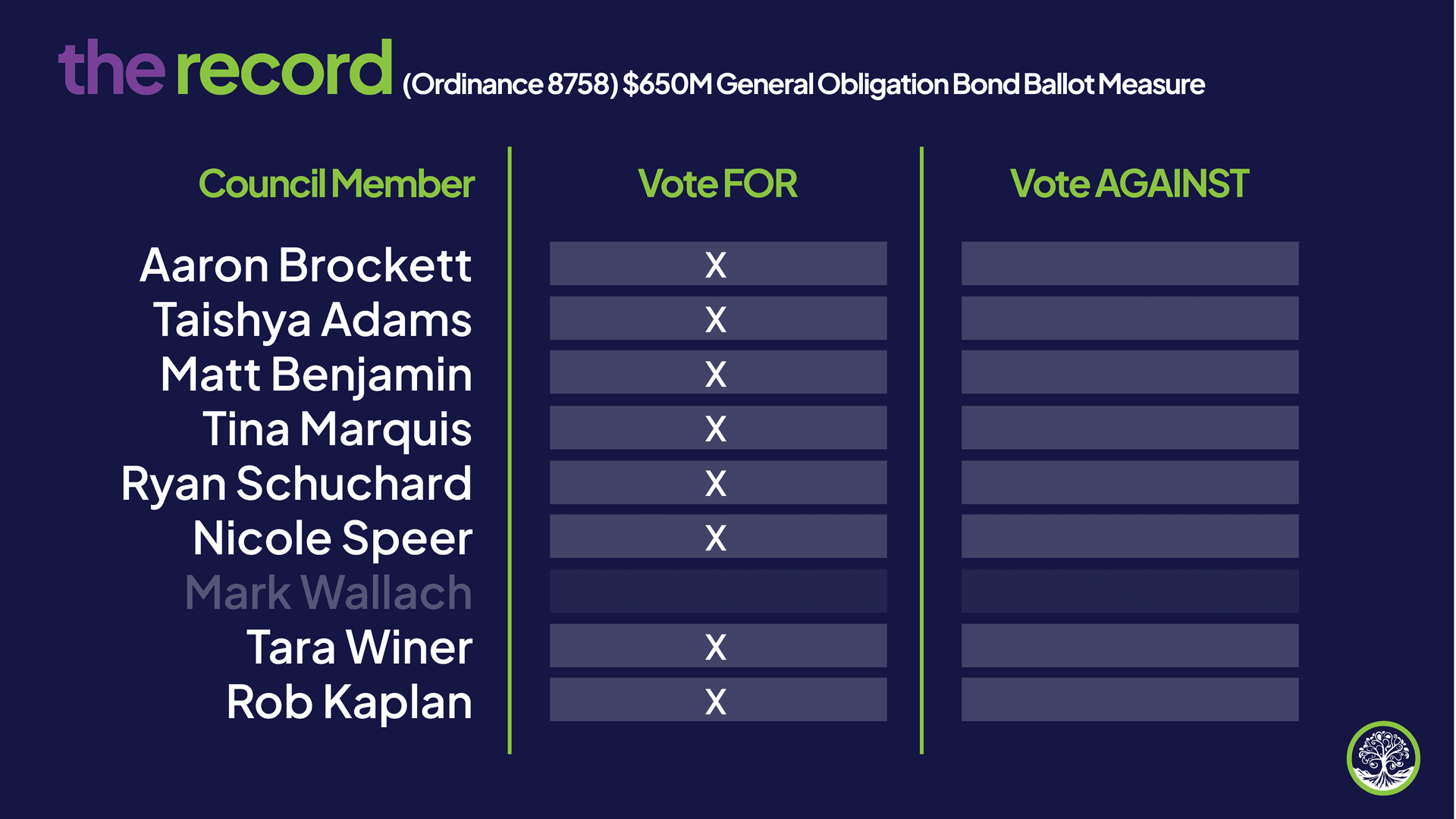
Public Hearing: Second reading and consideration of a motion to adopt Ordinance 8758 submitting to the electors of the city of Boulder at the Regular Municipal Coordinated Election on Tuesday November 3, 2026, the question of authorizing the issuance of general obligation bonds for financing community recreation, safety infrastructure, and other capital projects
Date of vote: 8/6/2026
Outcome: Passed 8-0
Category: Taxes and Fees
What Happened:
Council unanimously voted to place a $400 million General Obligation Bond (with a maximum payback of $650 million) on the November ballot. If approved by voters, the bonds would finance recreation facilities, public safety infrastructure and other capital projects and would be repaid through an increase in property taxes.
Council made one amendment to the ballot language, replacing the word "aquatics" in the South Boulder Recreation Center with the more specific term “lap pool.”
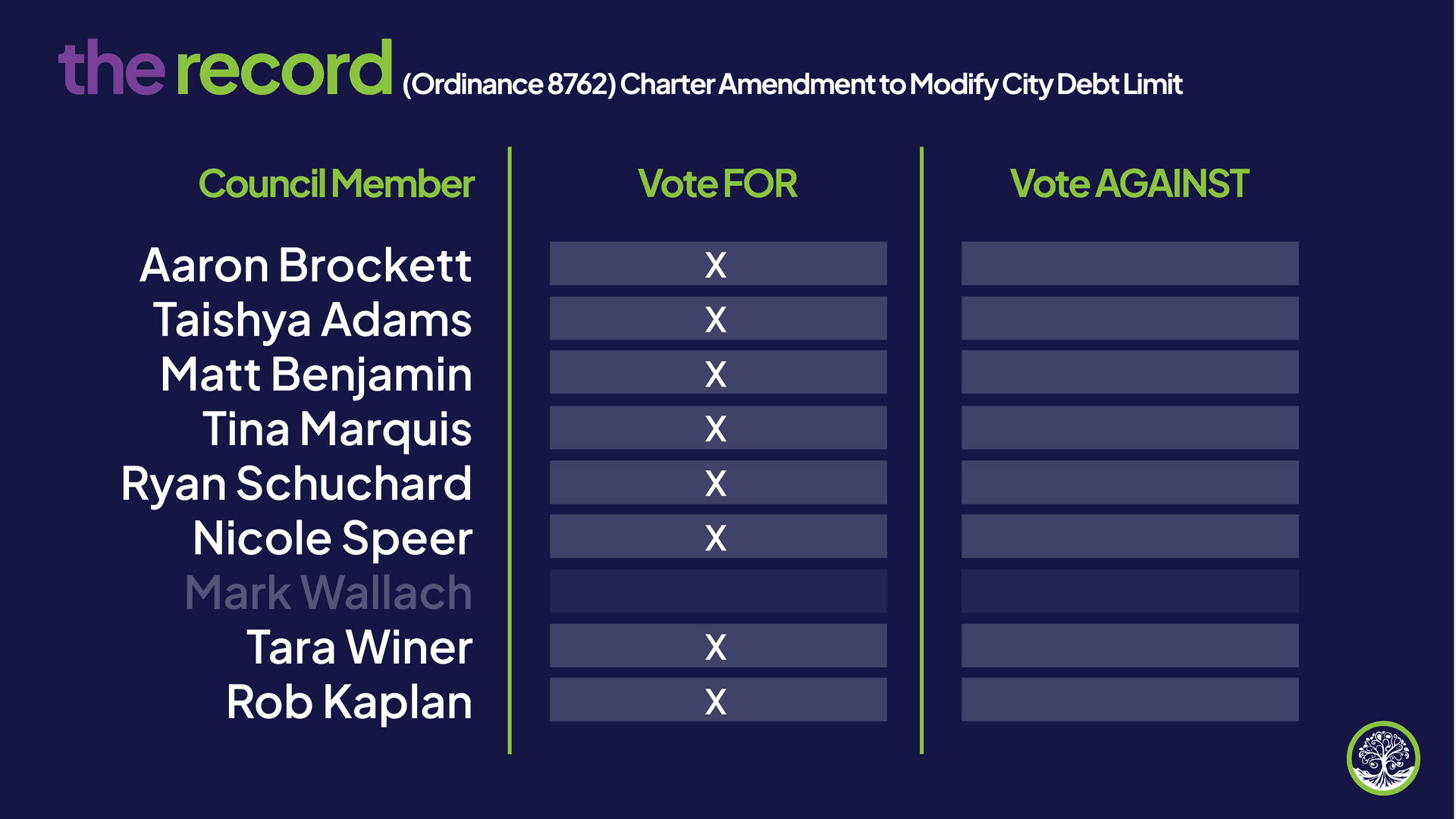
Public Hearing: Second reading and consideration of a motion to adopt Ordinance 8762 submitting to the electors of the city of Boulder at the Regular Municipal Coordinated Election to be held on Tuesday November 3, 2026, the question of authorizing an amendment of the Boulder Home Rule Charter to modify the calculation of the city’s debt limitation
Date of vote: 8/6/2026
Outcome: Passed 8-0
Category: Taxes and Fees
What Happened:
Council unanimously approved a Charter amendment that would modify how the City's debt limit is calculated.
This measure is directly tied to the bond proposal. Without this Charter change, the City would not have the legal authority to issue the amount of debt contemplated under the $400 million bond package.
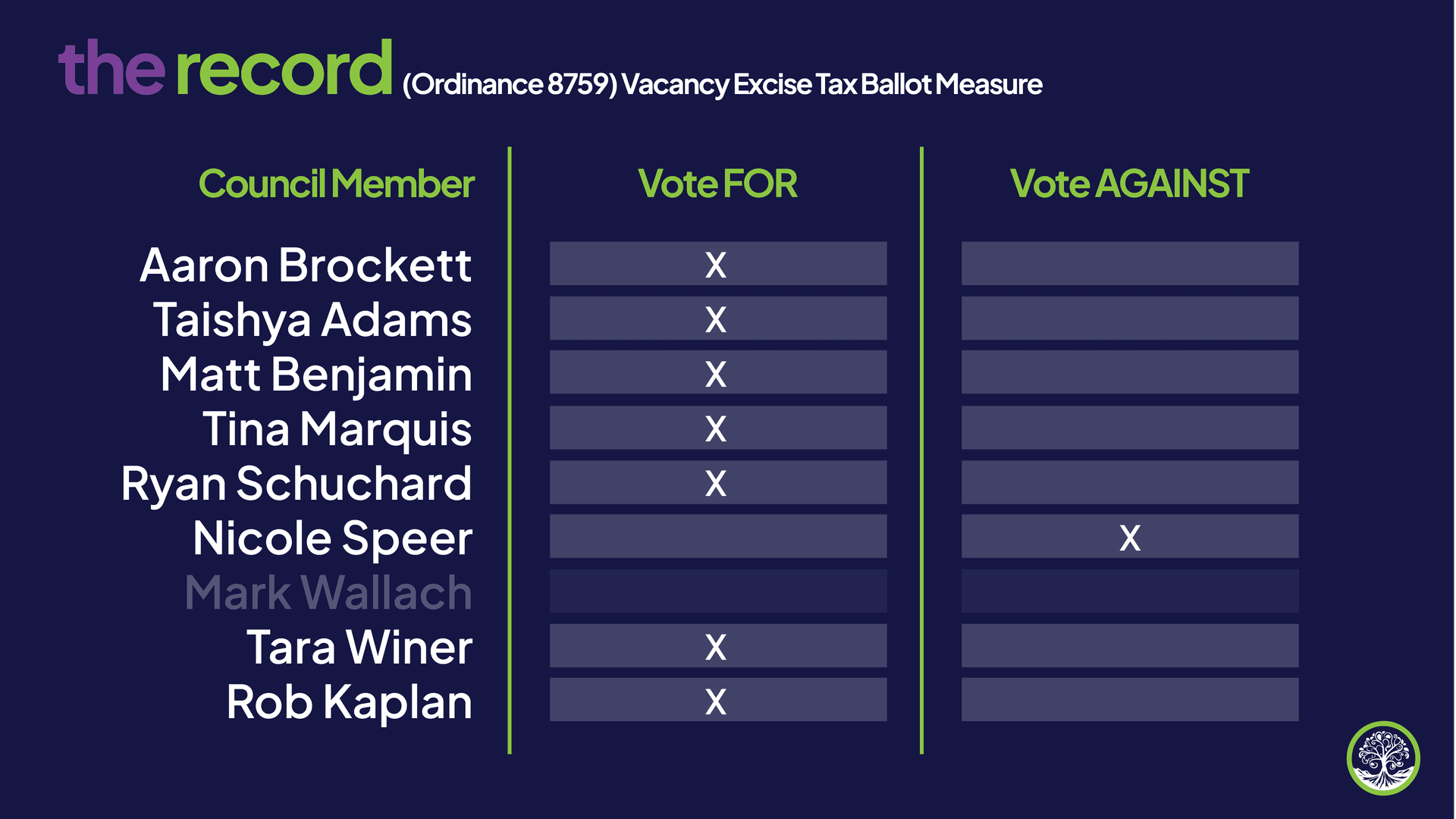
Public Hearing: Second reading and consideration of a motion to adopt Ordinance 8759 submitting to the electors of the city of Boulder at the Regular Municipal Coordinated Election to be held on Tuesday November 3, 2026, the question of raising taxes in the city of Boulder by the adoption of a Vacancy Excise Tax imposed on homes that are occupied for 183 days or less per year, with such amount to increase annually in accordance with the Denver-Aurora-Lakewood Consumer Price Index to support general city services
Date of vote: 8/6/2026
Outcome: Passed 7-1
Category: Taxes and Fees
What Happened:
Council voted to place a Vacancy Excise Tax on the November ballot.
The proposed tax would apply to homes occupied 183 days or fewer each year, with revenues supporting general city services.
Councilmember Nicole Speer cast the lone "no" vote. A concern with this one is that similar taxes are currently being challenged in court in other communities.
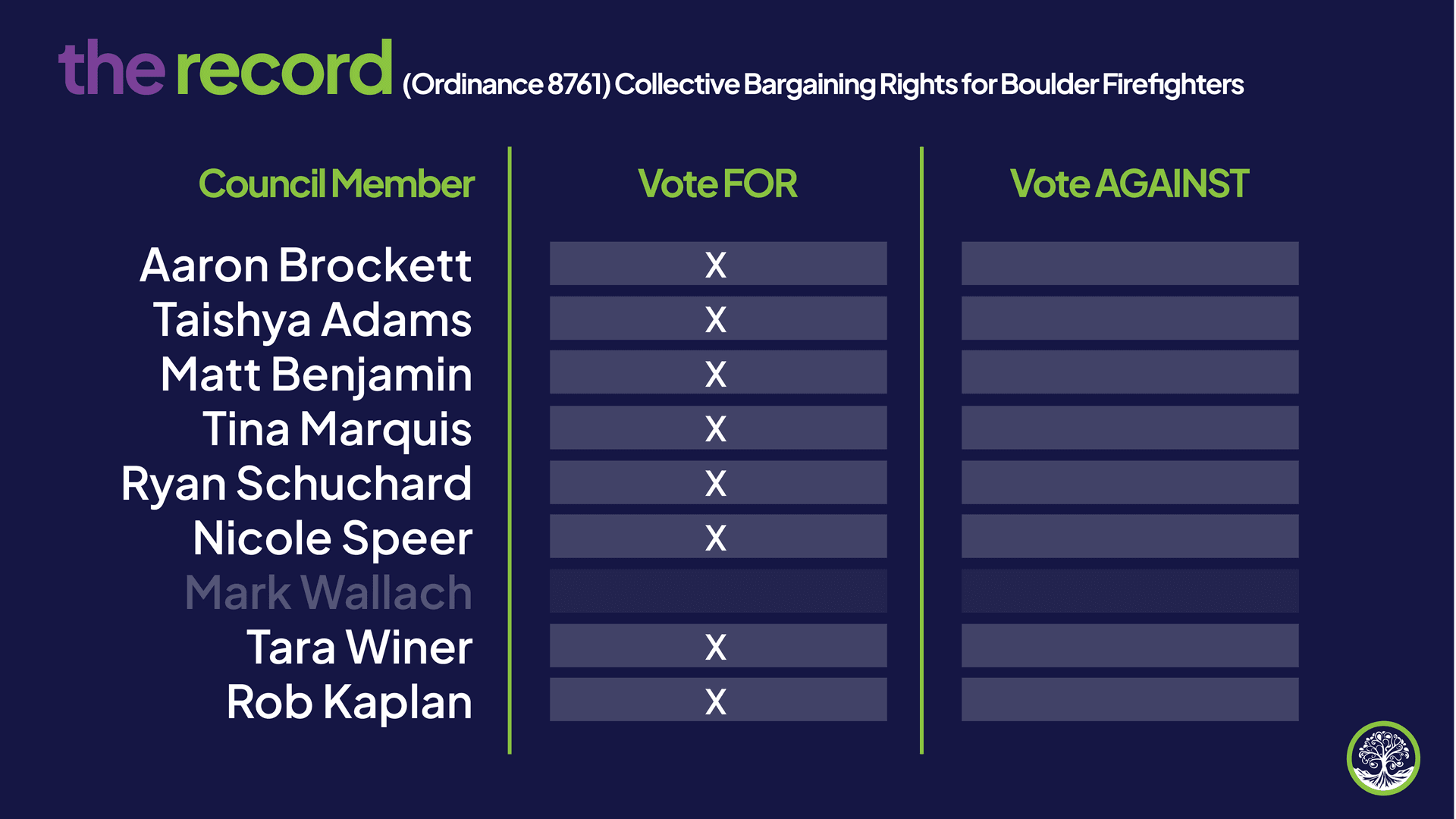
Public Hearing: Second reading and consideration of a motion to adopt Ordinance 8761 submitting to the electors of the city of Boulder at the Regular Municipal Coordinated Election to be held on Tuesday November 3, 2026, the question of amending the Boulder Home Rule Charter to add a new Section 73, “Collective Bargaining for Firefighters,” creating a charter guaranteed right for full-time fire department employees to bargain collectively
Date of vote: 8/6/2026
Outcome: Passed 8-0
Category: Other
What Happened:
Council unanimously referred a Charter amendment that would establish a charter-protected right for full-time Boulder firefighters to collectively bargain.
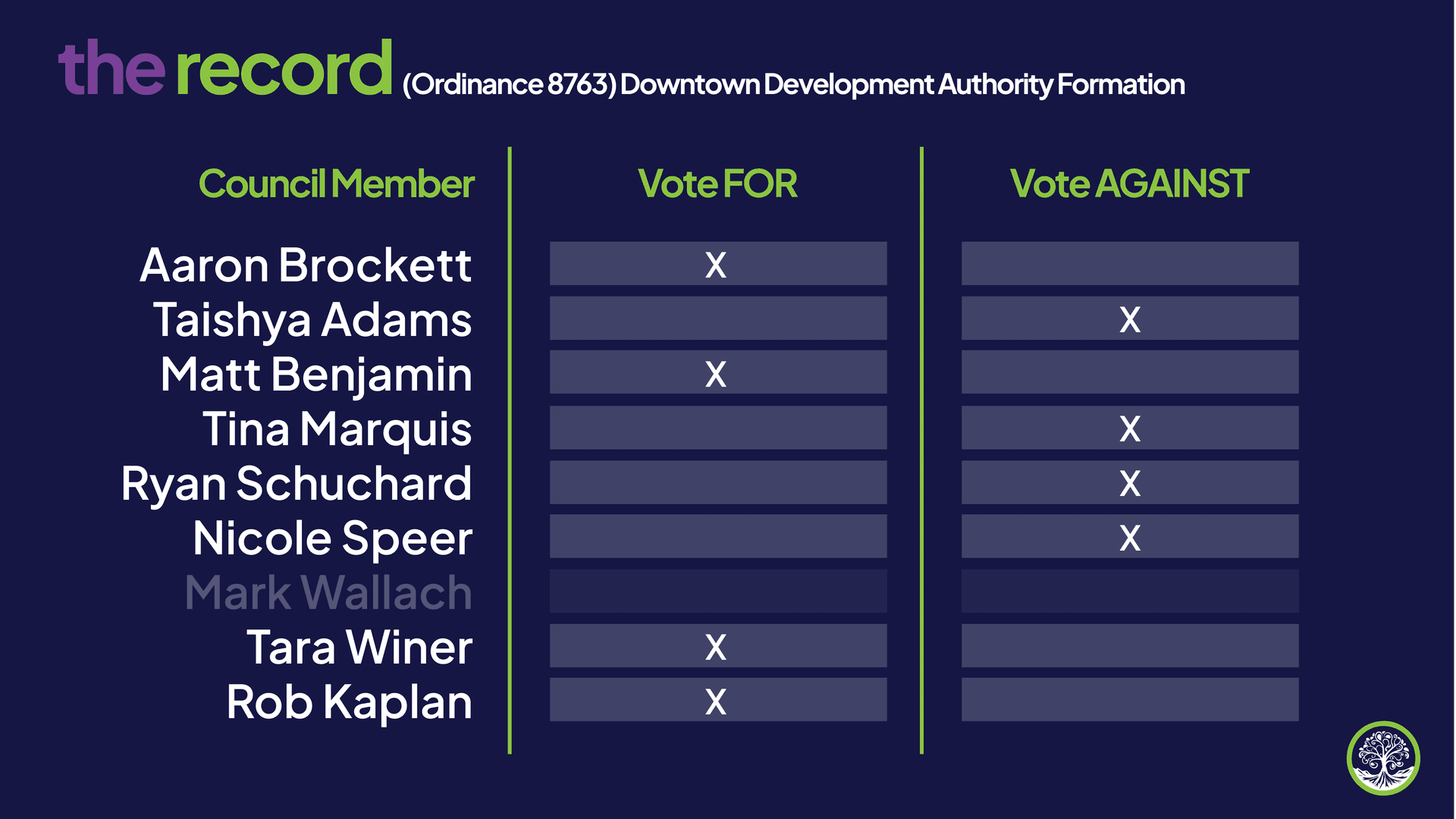
Public Hearing: Second reading and consideration of a motion to adopt Ordinance 8763 (1) determining the necessity of establishing the Boulder Downtown Development Authority, and (2) submitting to the qualified electors of the proposed Boulder Downtown Development Authority at the Regular Municipal Coordinated Election to be held on Tuesday November 3, 2026, the question concerning the formation of the Boulder Downtown Development Authority and a ballot issue to waive applicable revenue and spending limits in the city of Boulder, Colorado, declaring the necessity for an election on November 3, 2026, concerning the formation of such authority pursuant to Colo. Const. Art. X, Sec. 20 and statutory revenue limitations for such authority, allowing the city to pledge tax increment funds on behalf of the Boulder Downtown Development Authority, determining organizational aspects of the Boulder Downtown Development Authority board
Date of vote: 8/6/2026
Outcome: Failed 4-4
Category: Districts
What Happened:
After hours of passionate testimony from restaurant owners, retailers, commercial property owners and downtown advocates asking Council to let voters decide whether to establish a Downtown Development Authority, the proposal failed on a 4-4 vote.
Those voting against the measure cited concerns that there had not been sufficient community engagement and expressed concern that future tax increment revenues could otherwise benefit taxing entities such as parks, transportation and open space.
Supporters argued that the DDA represented one of the few meaningful economic development tools available to help reinvest in a downtown that continues to face significant challenges.
Because the ordinance failed, the question will not appear on the November ballot.
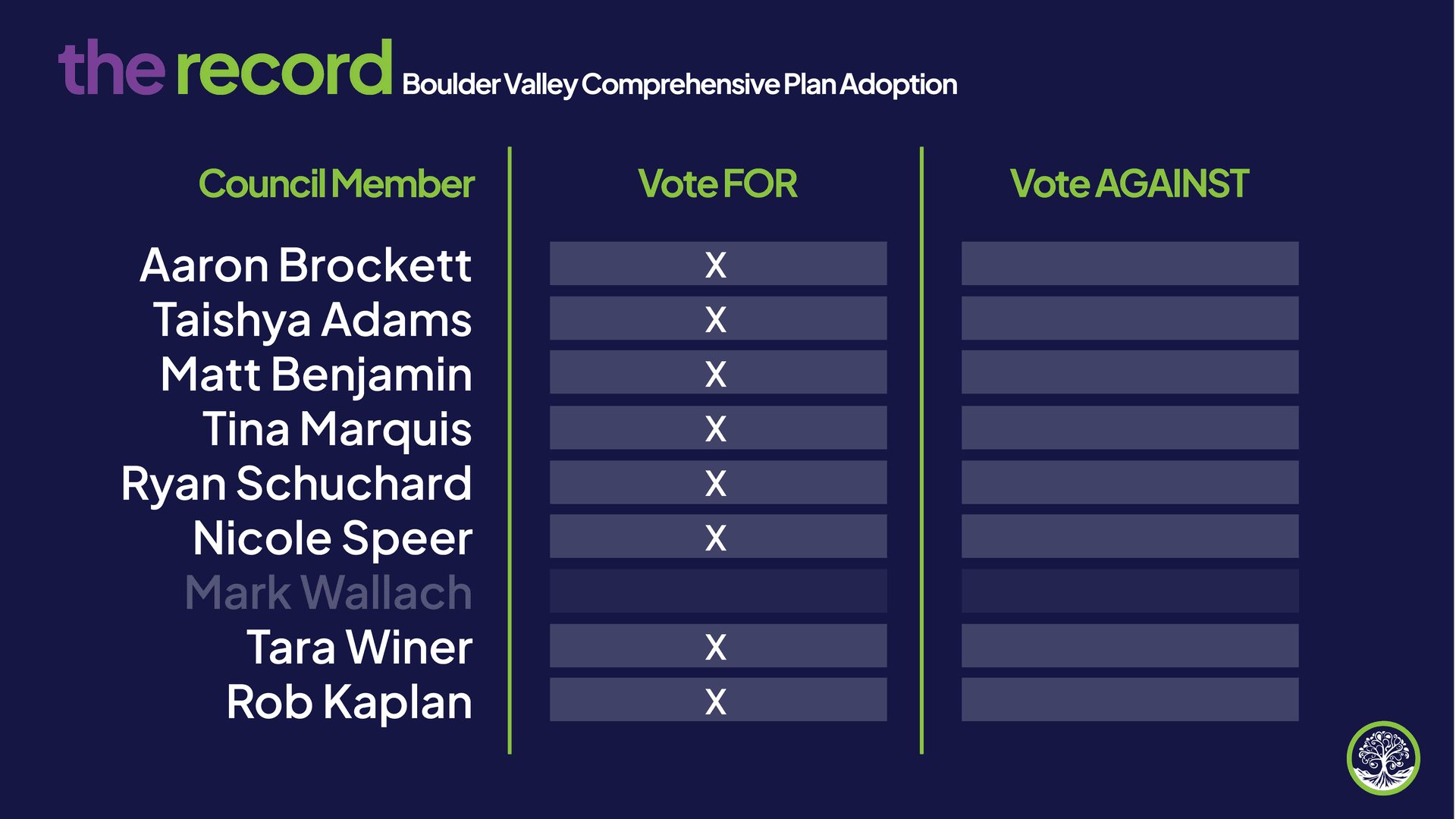
Public Hearing: Boulder Valley Comprehensive Plan (BVCP) Adoption: Consideration of one or more motions to: (1) approve or amend conditions of approval to the BVCP update made by the Planning Board; and (2) approve or amend conditions of approval to the BVCP update made by the Board ofCounty Commissioners; and (3) approve or amend recommended amendments to the BVCP update made by the Planning Board, County Planning Commission, and Board of County Commissioners.
Date of vote: 8/6/2026
Outcome: Passed 8-0
Category: Density
What Happened:
Council unanimously approved the remaining conditions of approval and amendments necessary to complete adoption of the Boulder Valley Comprehensive Plan, bringing this multi-year planning effort to its conclusion.
Jenny's Take
As I left Council Chambers Thursday night, I couldn't shake one question: How much debt is too much? In just the past few years, Boulder has committed itself to an extraordinary number of major financial obligations including: The South Boulder Creek Flood Mitigation Project, bonding backed by the Community, Culture, Resilience and Safety (CCRS) tax, Alpine-Balsam redevelopment, major recreation center investments, among others. And now Council is asking voters to authorize another $400 million+ in borrowing.
To be clear, many of these projects may be worthwhile on their own. But taken together, I believe residents deserve a much more transparent explanation of how all of these commitments fit together before being asked to take on another generation of debt.
Throughout the discussion, Council suggested that if this bond package does not pass, services and projects will have to be reduced. But before asking taxpayers for hundreds of millions of dollars, I think residents deserve answers to some fundamental questions.
What projects are absolutely essential? Which are priority? Which projects could be phased over a longer period of time? How much money could be generated through consolidation once Alpine-Balsam is completed? Which City buildings could eventually be sold and how can those funds help? Where can operational efficiencies be found? How much are our increasingly stringent building and energy requirements adding to construction costs? Most importantly, what alternatives were seriously considered before concluding that another $400-650 million in debt was the answer?
This conversation becomes even more frustrating because we've spent years hearing about the City's Long-Term Financial Strategy. After all of that work, is the big reveal really just asking taxpayers for another $650 million? That doesn't feel like a long-term “strategy”. It’s just another funding request by asking the community for a blank check.
A Bigger Governance Problem
Looking back over the last decade, I noticed something interesting. Not because Council's priorities changed. But because they largely didn't. Here are the priorities for the last 10 years:
2017- Affordable housing, climate, transportation, civic area, economic vitality
2018- Housing affordability, homelessness, transportation, climate, financial sustainability
2019- Housing strategy, climate mobilization, racial equity, Vision Zero, economic recovery
2020- COVID response, economic recovery, homelessness, climate, police reform
2022- Housing, homelessness, transportation, occupancy reform, Area III planning, living wage, airport, broadband, crime reduction, mental health response, small business support
2025- Fund Our Future, BVCP, homelessness, economic vitality, climate, transportation, governance, financial strategy, community safety, recreation investment
2026- Wildfire resilience, Fund Our Future implementation, BVCP completion, tipped wage review, Xcel reliability, Sundance preparation
Housing. Climate. Transportation. Homelessness. Financial strategy. These priorities appear year after year. Yet with only a few exceptions, I don't think most residents would say we've seen the kind of measurable progress one would expect after nearly a decade of focusing on the same issues. Nowhere in these priorities can you find, basic infrastructure, public safety, and only general references to economic vitality.
Every new Council understandably comes in with new ideas and new passions. During the annual retreat, priorities are established, staff pivots, and the focus shifts again. I think Boulder needs a different model. We should establish three permanent priorities that never change regardless of who is elected.
1. A Strong Local Economy: Because without a healthy tax base, everything else becomes harder.
2. Maintaining Our City's Infrastructure: Roads. Parks. Recreation facilities. Water infrastructure. Buildings. Taking care of what we already own.
3. Public Safety: Residents should never have to wonder whether basic safety services are adequately funded.
Every Council should absolutely pursue its own priorities and policy initiatives, but only after these core responsibilities are being adequately met.
The irony of the evening was not lost on me. Council voted unanimously to ask taxpayers to assume hundreds of millions of dollars in additional debt. Then, just minutes later, it voted down one of the few economic development tools intended to generate future investment in downtown Boulder and help repay the debt they just approved for the ballot.
Was the DDA proposal perfect? No. Could it have been improved? Absolutely. But there were three months between now and Election Day to continue working with businesses, property owners, residents and community partners to make it work.
Instead, the conversation ended before voters even had the opportunity to weigh in. Just one meeting ago, restaurants were left with no relief on the tip credit. This week, downtown businesses left without a DDA. And over the weekend, several businesses, including the beloved Lindsay's Boulder Deli, were vandalized. At some point we have to ask ourselves: How much more can Boulder businesses be expected to absorb before we stop asking businesses to carry the burden and start making economic vitality a governing principle instead of simply a campaign promise?