
Boulder City Council January 22nd Votes: Purchasing Procedures Update and Community Change Requests - BVCP Update


Hello friends!
At the January 22 meeting, City Council held two public hearings, one to update the city’s purchasing code, and another with far broader implications: advancing major zoning changes in several residential neighborhoods through the Boulder Valley Comprehensive Plan.
This week’s Dear Jenny features an interesting question about council priorities, and I think it’s a timely one.
I hope you enjoy!
Here we go.
The Record:
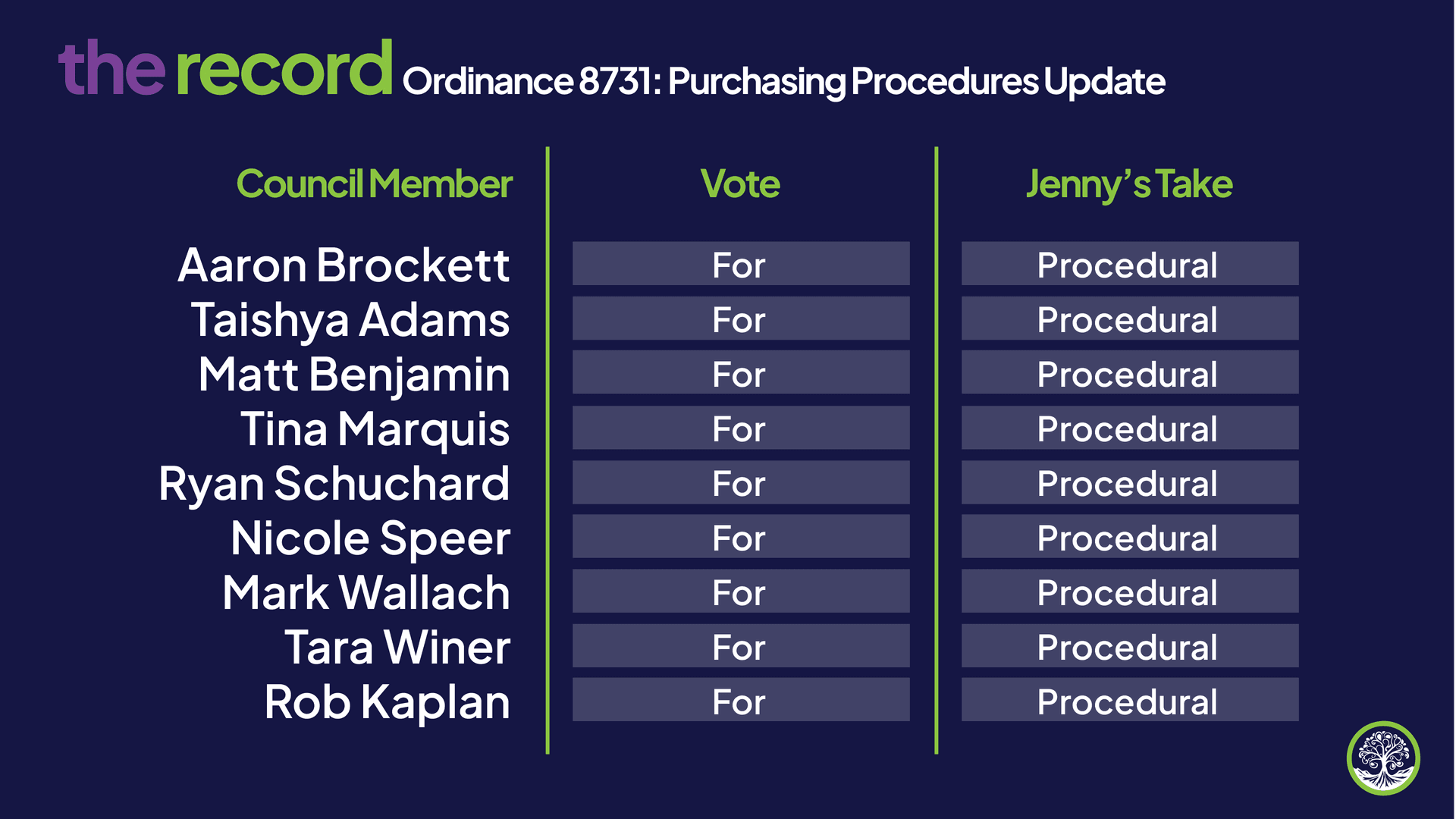
Council Approved: Ordinance 8731- Purchasing Procedures Update
Date of Vote: January 22, 2026
Vote: Unanimous | Ranking: Procedural
What Happened:
Council approved updates to the city’s purchasing and procurement code. The changes expand the City Manager’s authority to solicit and accept certain offers, enter into revenue-generating contracts, set bid-evaluation criteria (including equity and sustainability factors), and adopt administrative rules to implement and enforce purchasing policies.
What it Means:
In practice, it shifts more decision-making power from City Council to the City Manager’s office. That means:
- More flexibility and speed in contracting
- Fewer individual purchasing decisions coming before council
- Procurement standards (including sustainability and equity criteria) can change through administrative rules rather than public votes
Jenny’s Take
This vote is about administration, but procedural changes still shape outcomes.
Giving staff broader discretion should improve efficiency, but it also reduces transparency and public visibility into how large contracts are awarded, how vendors are evaluated, and how taxpayer dollars are ultimately spent.
This is the kind of policy that won’t make headlines, but over time it quietly determines which businesses can compete, how costs are controlled, and how accountable the system remains. It’s worth keeping an eye on how these changes are used.
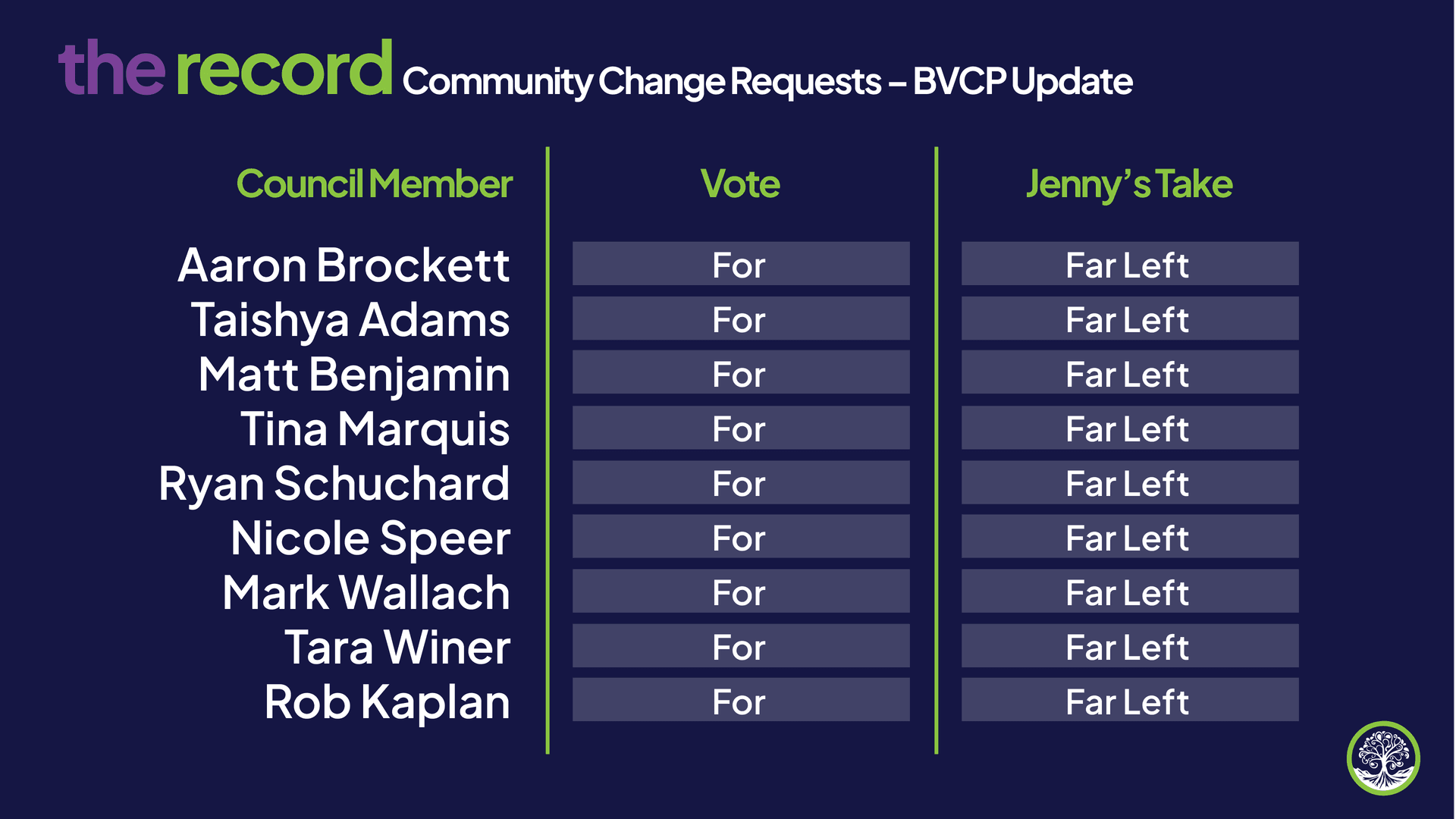
Council Approved: Community Change Requests – BVCP Update
Date of Vote: January 22, 2026
Vote: Unanimous | Ranking: Far Left
What Happened:
Council voted unanimously to approve a list of community change requests to be studied as part of the upcoming BVCP update, with amendments. The staff recommendation options were to “Consider Further”, “Do Not Consider Further”, or rank as “Ineligible”. Link to packet here. This agenda item begins on page 67.
What was submitted:
- 34 total requests
- 22 land-use designation changes
- 3 planning area map changes
- 9 policy/text changes
Staff recommendations:
- Consider Further: All requests that increase density
- Do Not Consider Further: All requests to change land to open space
- Do Not Consider Further or Ineligible: All policy requests except one
Council amendments:
- Removed Request #10 the Sioux Drive / Frasier Meadows high-density expansion
- Added back Policy Requests #26 (wildfire) and #27 (Agriculture water delivery) for staff review
Public Comment:
Seven residents spoke during public comment.
Six of the seven speaking addressed and opposed the Sioux Drive / Frasier Meadows rezoning request directly, citing neighborhood impacts, scale, and concerns about advancing large zoning changes through the BVCP rather than a site-specific public process.
Council’s removal of Request #10 followed this testimony.
Policy Requests Council Added Back:
Despite staff recommending denial, council voted to include the following two policy items for further review:
- Request #26- Regional Wildfire Mitigation Program
A proposal calling for a funded, regional wildfire mitigation program addressing ignition sources, fuel management, structural hardening, and emergency response. Staff recommended denial because it goes beyond the BVCP’s “vision-level” scope into program design and implementation.
- Request #27- Agricultural Water Infrastructure Partnerships (Policy 9.01)
A request to add policy supporting city-county partnerships with farmers, ranchers, and ditch companies to fund and upgrade agricultural water delivery systems. Staff also recommended denial because it extends beyond the plan’s scope and planning area.
Examples of Policy Requests That Were Denied:
Several substantial policy proposals were not advanced. For example:
- Request #30: Require resident initiation for annexation of Area II lands
- Request #31: Clarify that community benefits do not automatically justify added building height
- Request #32: Require resident initiation for Gunbarrel annexation
- Request #33: Evaluate and revise land use map designations for accuracy, focusing on Open Space classifications, and enhance land use designation map legibility.
Jenny’s take:
I am extremely concerned about how much zoning policy is being shaped through the BVCP community change request process.
The comprehensive plan is supposed to be a high-level, long-range vision document. In practice, it is increasingly being used to quietly advance large-scale zoning changes that later move forward with far less public attention when the actual code amendments appear.
Even with the Sioux Drive portion removed, we are still talking about major land-use changes affecting entire neighborhoods and public assets like the Iris ballfields, bundled into a technical planning process most residents will never follow.
If the city wants to pursue significant up-zoning, it should do so directly, clearly, and with project-specific public engagement, not through a planning framework that quietly sets the table for future decisions most people won’t realize have already been made.
That is why I am ranking this vote Far Left: not because of one parcel, but because of the broader direction systematically expanding density through a process that minimizes visibility, limits meaningful public participation, and reshapes neighborhoods long before residents understand what’s happening. Council had the chance to review and remove whatever they so chose. What troubles me was the inconsistency in how specific properties were treated.
When the Sioux Drive / Frasier Meadows request came up, Tara introduced its removal, and council agreed by straw poll (7–2, with Nicole and Ryan asking for more information). Yet when Mark raised concerns about the Iris property, pointing out that rezoning the entire parcel now could cause the city to lose long-term leverage over publicly owned land, the council dismissed the idea of adding safeguards or conducting further evaluation.
One property received caution and restraint. The other, publicly owned land tied to community assets like the ball fields, moved forward without similar concern.
That contrast, plus the sheer amount of upzoning council allowed to move forward, is hard to ignore.
When this comes back in the spring, it will be critical that residents pay attention. Decisions made now will determine whether the city preserves flexibility over that land or quietly gives it up through zoning changes before the public fully understands what is at stake.
Some may argue this vote was merely procedural, not ideological. I strongly disagree.
Votes like this are the first real steps in shaping the future of our city. Approving evaluations for this many high-density zoning changes in a single motion is not neutral. It sets direction. It signals priorities. And it lays the groundwork for what will later be presented as “already vetted” or “previously considered.”
That is why this vote matters. This is not procedural. This is how the future land map of Boulder is drawn, one “technical” vote at a time.
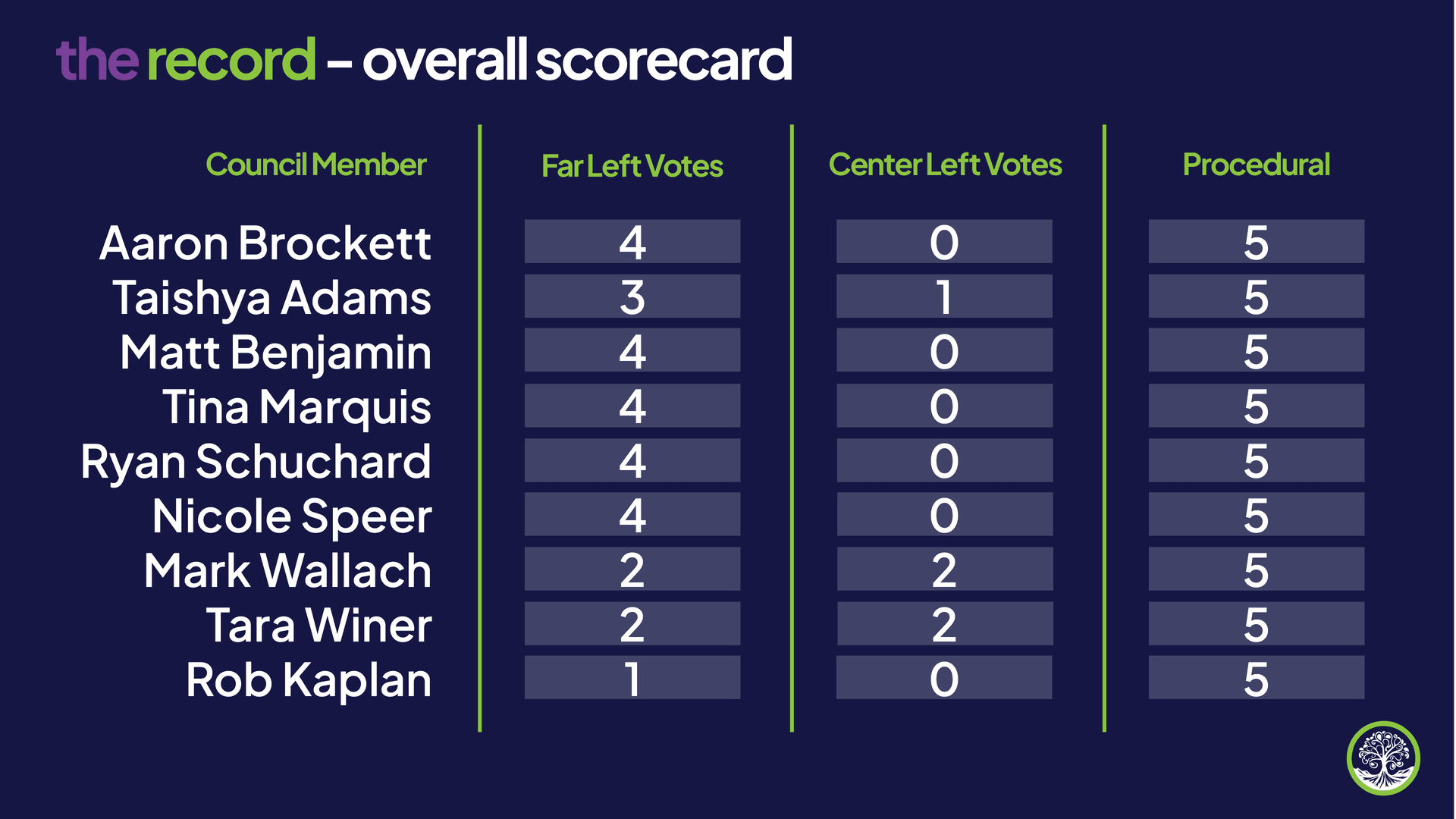
Quick Recap: Non-Public-Hearing Votes
In addition to the public hearing items, the Boulder City Council approved several procedural and administrative actions that did not include formal public testimony.
- 2026 council committee appointments
- Utility easements at Alpine-Balsam
- Scheduling of a future special meeting
- A formal council letter to Xcel Energy
Council unanimously approved sending a formal letter to Xcel Energy outlining concerns with the city’s franchise and energy partnership. The letter focuses on reliability problems (including recent power shutoffs and outages), Xcel’s failure to meet 2022 and 2024 emissions targets, slow progress on partnership commitments like fleet electrification and streetlight acquisition, rising affordability issues for residents and businesses, and public-health risks tied to the legacy operations and cleanup of the Valmont coal plant. It also sets expectations for future performance and makes clear that council will evaluate Xcel’s progress on climate goals, wildfire mitigation, affordability, and system reliability as part of future decisions about the franchise agreement.
I support council putting these concerns in writing, but letters alone don’t change outcomes. Xcel has heard many of these same issues before reliability, wildfire risk, emissions targets, affordability and progress has been slow. What will matter is whether council is willing to tie future franchise decisions and regulatory leverage to measurable performance, not just promises. If this letter becomes part of a clear accountability framework, it could be meaningful. If not, it risks being another well-written document that makes residents feel heard without materially improving service, safety, or costs.
Warmly,
Jenny
Founder, Jenny on the Record