Boulder City Council May 21st Regular Meeting


Hello Friends,
This week’s meeting included a procedural, unanimous public hearing vote on budget adjustment. But the real discussion happened during Matters from Mayor and Council, and it focused on something that is quietly shaping major outcomes: straw polls.
The Record:
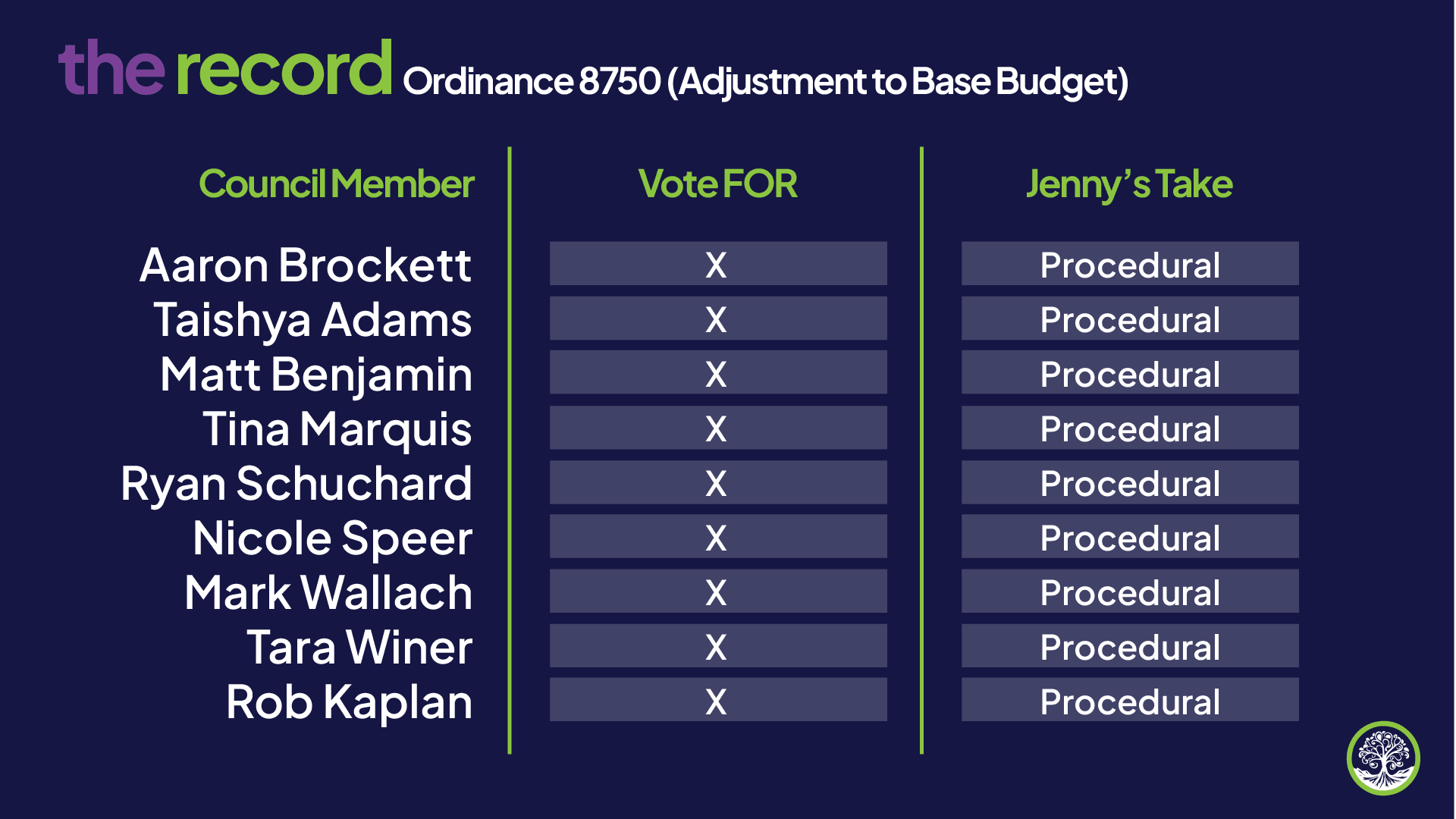
Public Hearing: Ordinance 8750- Adjustment to Base Budget
Date of vote: 5/21/2026
Outcome: Passed Unanimously
Classification: Procedural
What Happened
Council held a second reading and public hearing on Ordinance 8750, the city’s first 2026 Adjustment to Base Budget. I reported on the second 2025 ATB in December. As previously mentioned, this is a standard biannual budget process where the city adjusts the adopted budget to account for things like grants received, project carryovers, unanticipated costs, and dedicated funds that need to be reappropriated.
For 2026 ATB1, staff recommended $18,585,227 in total budget adjustments, including about $13.1 million from fund balance, $5.3 million in revenue from mid-year grants, and $129,054 in additional unbudgeted revenue. Staff emphasized that most of the fund balance use was restricted or already dedicated to specific purposes, not broad new spending.
Notable items included a $4.0 million carryover in Housing and Human Services for delayed Affordable Housing Fund projects like Rally Flats, 34th Street, and Spine Road, and a $7.3 million allocation for radio replacements across Police, Fire-Rescue, Open Space, and other services, advancing a planned 2027–2028 replacement to support critical communications infrastructure.
After the public hearing and discussion, council voted unanimously to adopt Ordinance 8750.
Bonus Topic: Matters from the Mayor and City Council
Council had a candid conversation about how straw polls are being used (especially during study sessions) and whether they are doing more than intended. A few things were made clear:
Straw polls are not formal votes
They are used to test consensus and guide staff
But here’s the tension. Council members are concerned that straw polls are increasingly being used on big policy questions, not just minor direction. They are also concerned that the polls are indicating early sentiment, which can be personally problematic for individual council members. But staff relies on straw polling direction to move work forward. That creates a gap. Straw polls are not supposed to decide important issues, but they are often deciding what happens next.
Why It Matters
This isn’t theoretical. We’ve already seen this play out across major issues over the last few months:
Airport
The recent direction to continue operating the airport came through a straw poll. That moment should be shaping funding strategy, legal positioning, and the long-term use of the site. However, because a few council members are now questioning the process, the airport will be discussed again this Thursday, and the delay has already cost the city nearly $150k in taxpayer funds.
This is an interesting issue because continuing to operate the airport reflects the existing land use and technically should not require a public hearing or a vote to maintain the status quo. It is not council’s job to manage the taking of grants, that is an administrative function that lies with staff. But given the level of community interest, council has chosen to revisit the conversation and may bring it back for a formal public hearing vote. Watch for this next conversation on Thursday.
Ballot Measures
At the March 12 study session, eight potential ballot measure options were presented to council. All eight were polled, and council recommended four via majority straw poll. After the meeting, Tara Winer decided she wanted to withdraw one of the measures she had supported. Because she was the fifth vote, that change would have removed the option from the list. She submitted the request via hotline. Staff advised that the straw poll direction could not simply be overturned and needed to return through agenda setting. When the conversation was revisited at the May 7 study session, staff ultimately presented that the ballot measure option she had attempted to withdraw was not a viable option for a potential ballot measure.
Tip Credit
Another straw poll signal that helped guide what staff modeled and will bring back was on tip credit. Four options were presented, including the status quo. There was not a clear majority for status quo, as most council members appeared to support expanding the credit. Tina Marquis then voted for the status quo to keep that option alive. During the May 21 meeting, council and staff agreed that the status quo should generally remain on the table, and that the options presented for direction should focus on new areas for staff exploration.
Jenny’s Take
This conversation gets to a bigger question: When is a decision actually made and what problem are we trying to solve?
On paper, what matters is the final vote. Straw polls, or a nod of five, are meant to set direction, prioritize staff time, and shape what options come back. The issue is not that straw polls exist. They are a useful tool. The issue council has is how much they are doing without being treated like final decisions, and how council members are perceived politically before the final vote.
If direction is given too early, it can quietly lock in a path. According to Council, if they later try to revisit it, it creates confusion for staff and the public. That tension was clear in this discussion.
The three things solved in this conversation were the feedback about consensus by renaming straw polls to “non-binding nod of five”, a change in rules and procedure that will clarify that informational items are allowed to be brought to study sessions, and a request for staff to provide look ahead items on the agenda.
In my opinion, a “Non-Binding Nod of Five” functions the same as a straw poll. It will be interesting to see how staff manages situations where a council member changes their position after giving that direction under a new name. I see this largely as an optics issue. Council is getting pressure from the community on the direction they are giving, so they are working to make it feel less like a vote.
The real weight is the final vote, which is why I only track public hearing final reading votes. Council members can change their minds at any time before that. I do take issue that we are currently delaying important conversations and forward movement because the current process may make individual council members appear unfavorable to their voters.
Council was elected by the community and should stand by any vote or poll taken throughout their term without needing to get so far in the weeds that we are focusing on a process that is primarily an image problem, instead of the large city issues that should be prioritized. I hope that this conversation puts this issue to rest so we can get to the real business of the city.
Thank you for reading!