
Boulder City Council May 28th Special Meeting


The Record:
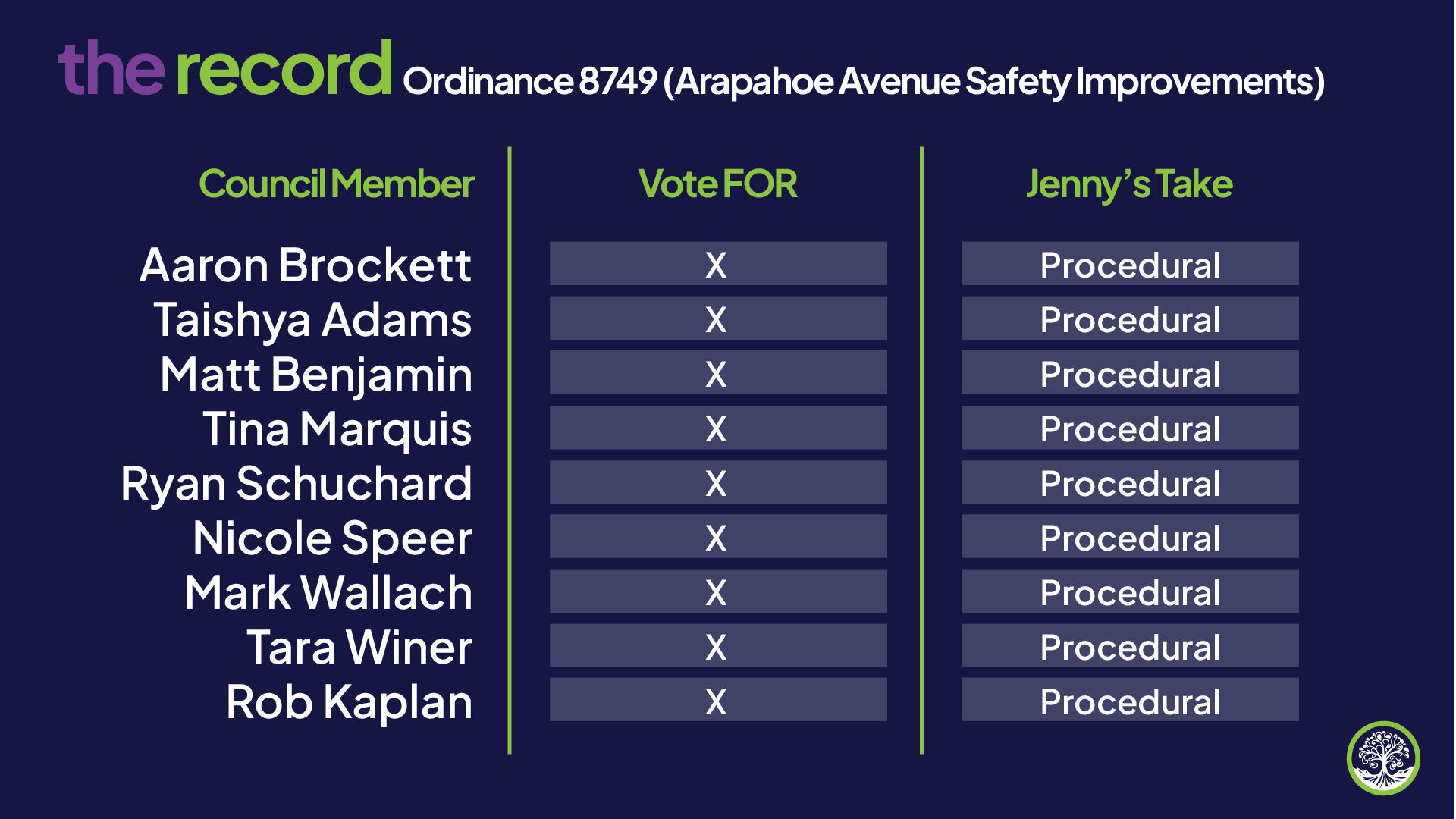
Public Hearing: Ordinance 8749 – Arapahoe Avenue Safety Improvements
Date of vote: 5/28/2026
Outcome: Passed Unanimously
Classification: Procedural
What Happened
Council held a second reading and public hearing on Ordinance 8749, which authorizes the city to acquire property interests needed for the Arapahoe Avenue Safety Improvements Project between 28th and 38th. The estimated total cost of the project is $12.07 million. The city received federal grant funds to implement the project and will provide a 20% match, $2.41 million, toward the total improvement costs. Matching funds are included in the approved Capital Improvement Program.
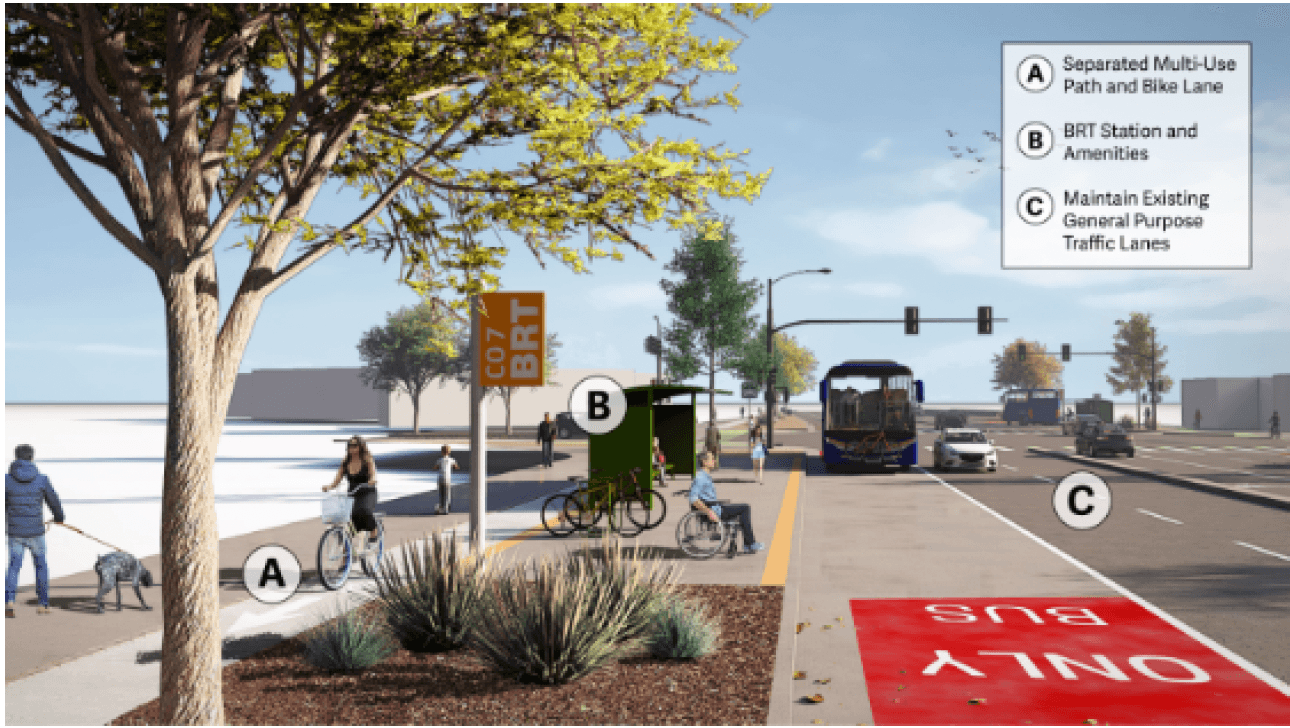
The project includes protected bike lanes, multi-use paths, and transit improvements, while maintaining existing travel lanes. Because the current right-of-way is not wide enough, the city needs to acquire portions of adjacent properties, including easements and limited right-of-way.
The ordinance allows the city to acquire those property interests through negotiation and purchase, and if necessary, through the power of eminent domain.
Staff was clear that the intent is to negotiate in good faith with property owners and provide compensation based on fair market value. Eminent domain is not the preferred path, but the authority is being requested upfront to ensure the project stays on schedule and meets federal funding deadlines.
This approach has been used in prior transportation projects, where the authority was granted but only used in limited cases when agreements could not be reached.
After the public hearing and discussion, council voted to adopt Ordinance 8749. Here is a rendering of the proposed project.
Why It Matters
This is a good example of a vote that is procedural in nature but still carries real implications.
On one hand, this is standard practice. Infrastructure projects often require small pieces of land, and having eminent domain authority in place helps avoid delays and ensures consistency across property owners.
On the other hand, it raises a broader question about how and when the city uses its authority to acquire private property, even when the intent is to negotiate first.
It also highlights the reality that many of Boulder’s transportation goals, especially around safety and multimodal access, depend on expanding beyond existing right-of-way, which is not always straightforward.
Jenny’s Take
This is one of those votes where everything is technically routine, but still worth paying attention to.
The city is not saying it will use eminent domain. It is saying it needs the option available in order to deliver the project on time. That’s an understandable position, especially with federal funding deadlines in play.
At the same time, this is a reminder of how projects move from concept to reality. Plans like protected bike lanes and safer corridors often sound simple, but they require real tradeoffs, coordination, and sometimes difficult negotiations with property owners.
In this case, council supported giving staff the tools to move the project forward. The real test will be in how that authority is used.
Bonus Topic: Airport (again)- Reopening the Decision
What Happened:
Council did not take a formal vote on the airport last week, but they did take two separate “nods of five” that effectively reset the timeline.
First, there was agreement (a nod of five) to bring the airport back for a formal public hearing, even though a prior straw poll in April had already given direction to continue operations. This passed 8-1.
Second and more significantly, there was a separate nod of five directing staff what to study before that hearing. Council asked staff to come back with analysis on two paths:
Accepting FAA grant funding, which may include long-term or perpetual obligations to keep the airport operating (a position we may already be in)
Identifying alternative funding sources that would allow the city to maintain more local control and potentially avoid those FAA obligations
That second nod of five is what changes the trajectory. It passed 5-3 with support from:
Nicole Speer
Ryan Schuchard
Tina Marquis
Mark Wallach
Rob Kaplan
Notably, Rob Kaplan’s vote represents a shift from the direction he supported in April. Tara Winer abstained from this poll.
Because of this added scope, staff now needs time to develop both options, which means the public hearing is pushed out by several months.
Why This Matters:
This is no longer just about whether to hold a public hearing, it’s about reopening the core policy question.
Instead of advancing the prior direction (continuing operations and allowing staff pursuing FAA grant funding which is a staff administrative function), council has asked staff to rebuild the decision framework, analyze alternatives, and return later.
That has real implications including delays in securing funding, extended uncertainty around the airport’s future, issues with finalizing the upcoming budget conversations, and additional staff time, legal review, and cost.
To date, these delays have already cost taxpayers approximately $150,000, and that number will continue to rise as the process stretches out and staff is unable to move forward with all funding opportunities.
Jenny’s Take:
The April straw poll provided direction. Staff could have been moving forward on funding, strategy, and long-term planning. Instead, we are now, revisiting the same question, expanding the scope of analysis, and delaying action in a fiscal environment where every dollar counts.
If council wants a formal vote, that’s reasonable. But layering in new alternatives after direction has already been given effectively resets the decision, not just formalizes it.
And that comes with a cost in time, in money, and in momentum. At some point, we have to decide whether we are making decisions or continuously studying them.
Thank you for reading!