
City Council unanimously approves Arapahoe Avenue Rezoning


Scorecard Update
Before jumping into this week’s vote, a quick note about the scorecard.
Based on feedback from readers, I’ll be updating how council votes are categorized. The scorecard will show issue-based rankings, focusing on how votes align with key policy areas that consistently shape Boulder’s future such as Land Use & Density, Housing & Affordability, Climate & Sustainability, Transportation & Mobility, Taxes & Fees, and Process & Procedural. The current scorecard accounts for the votes we have had to date.

The goal remains the same: to track how council members vote. This adjustment simply aims to make the framework clearer and keep attention on the decisions themselves.
Now, on to this week’s vote.
Public Hearing: Arapahoe Avenue Rezoning (5501 & 5505 Arapahoe)
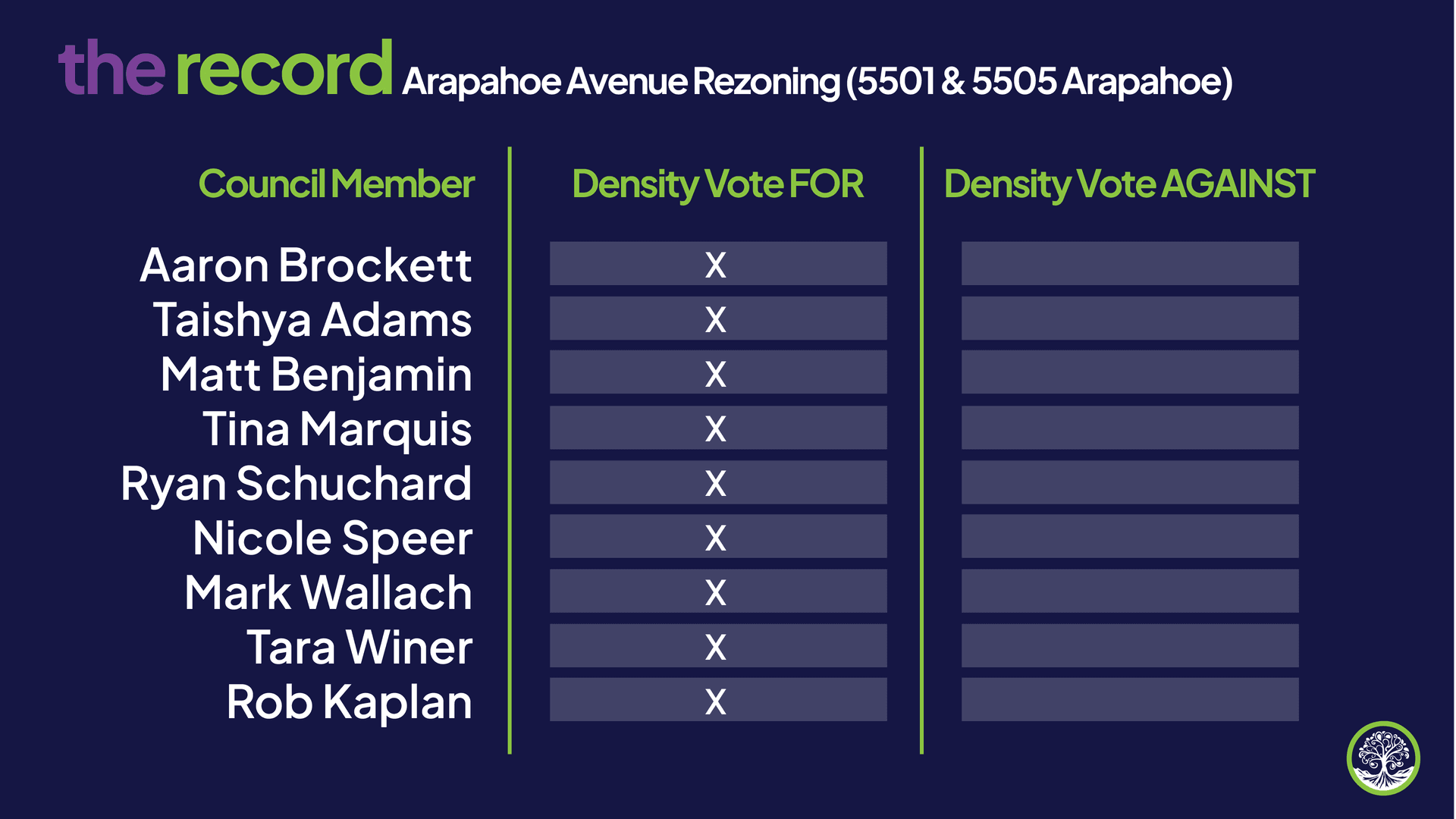
Date of Vote: 2/5/2026
Vote: Unanimous
What Happened
Council held a public hearing on ordinances to rezone two properties along Arapahoe Avenue at 5501 and 5505 Arapahoe from Business–Community (BC-1) and Industrial zoning to Mixed Use 4 (MU-4).
The rezoning also includes adjacent right-of-way areas along Arapahoe Avenue and 56th Street.
After public testimony and council discussion, the proposal was approved unanimously, allowing the sites to move forward under MU-4 zoning, which supports a broader mix of uses and typically allows more intensive redevelopment than the previous zoning.
Background of Property
For decades, the most visible property on this block was the Boulder Dinner Theatre (BDT Stage) at 5501 Arapahoe Ave., a staple of Boulder’s cultural scene since its founding in 1977 by Ross Haley. The dinner theatre became one of Colorado’s longest-running performance venues, hosting musicals, plays, concerts, and community events for more than four decades. In 2022, the then-owners Gene and Judy Bolles sold the building and property to a real estate investment group, marking the beginning of the end of BDT Stage at that location. Under the sale agreement, the company was able to operate through a final season, but the sale signaled that its days in that building were largely finished and aligned with broader redevelopment plans for the corridor.
Earlier history along this stretch of Arapahoe
Historic records from the broader 5500–5700 blocks of Arapahoe show that these addresses have long been part of Boulder’s early eastside commercial and social life. In the mid-20th century, the site and nearby parcels hosted businesses like Roxwood Park Cottages and other roadside establishments that served travelers and locals. This helps us reflect on the evolution of Arapahoe from a rural road into a significant urban corridor.
What Was the Property Zoned Before this Change: The properties were primarily zoned BC-1 (Business–Community 1), with a portion of adjacent land zoned IG (Industrial–General).
BC-1 (Business–Community 1) allows:
This zoning is intended for auto-oriented commercial uses along major corridors, and typically includes, Restaurants and retail, Offices and service businesses, Entertainment venues (like the former Dinner Theatre), Auto-oriented commercial uses, Limited residential, usually secondary to commercial uses.
Development under BC-1 tends to produce single-purpose commercial sites, large parking lots, and lower-intensity buildings.
IG (Industrial–General) allows:
Industrial zoning typically supports, Warehousing and light industrial uses, Flex industrial and commercial spaces, Contractor yards and service operations, Limited office or commercial uses tied to industrial activity
These zones are focused on employment and service uses, not housing or mixed-use neighborhoods.
MU-4 (Mixed Use) Zoning Allows:
The new zoning, Mixed Use 4 (MU-4), is designed for major corridors and activity centers where the city expects future growth to occur.
MU-4 allows Mixed-use buildings combining residential and commercial, Housing as a primary use, Offices, retail, restaurants, and services, Higher building intensity than BC-1 or IG, Development designed for more walkable, urban-style corridors.
In short, MU-4 zoning makes it possible to build housing and mixed-use projects, rather than just standalone commercial or industrial uses.
Why It Matters
Rezoning decisions are important because they determine what type and scale of development can occur in the future. While no project is approved by this vote, the zoning change sets the framework for what may eventually be built at these locations along one of Boulder’s primary corridors.
These corridor rezonings are part of a broader shift toward mixed-use redevelopment along major transportation routes, where the city expects future housing and commercial growth to occur.
Jenny’s Take
This vote is pro-density. It is less about a single project and more about the continued direction of redevelopment along Arapahoe, where council appears aligned that mixed-use growth should continue.
At the same time, Boulder already has a significant amount of underutilized mixed-use commercial space and empty apartments in that area. Many residents question whether simply adding more zoning capacity will actually deliver affordability or community benefits. Rezoning creates opportunity, but it doesn’t guarantee the outcomes people hope for.
As always, my goal here is simply to track how decisions are made and how council votes shape Boulder’s long-term direction. Density votes matter, because zoning decisions quietly set the stage for what comes next.
State Policy Highlight
Council Reviews State Housing Bill HB26-1001
As part of council’s approval of Boulder’s 2026 Policy Statement on Regional, State, and Federal Issues, council discussed how the city should respond to pending state legislation, including HB26-1001, often referred to as the Home Act.
The bill would significantly limit how much control cities have over housing development by allowing certain housing projects to move forward regardless of local zoning rules, including restrictions on density, height, and location.
In practical terms, this means projects meeting state criteria could bypass many of Boulder’s local land-use standards. Housing built under the bill could also be entirely market-rate, beyond Boulder’s existing inclusionary housing requirements.
Supporters argue the bill is needed to address Colorado’s housing shortage and speed production statewide. Critics, including several council members and myself, worry it would override Boulder’s long-standing local planning framework and reduce community input into where and how growth occurs.
Jenny’s Take
I strongly disagree with this bill. While increasing housing supply is an important statewide goal, HB26-1001 goes too far by stripping local governments of their ability to decide where and how growth should occur.
Boulder has spent decades building community-supported plans that balance housing, infrastructure, environmental constraints, and neighborhood impacts. This legislation would override much of that local decision-making and replace it with a one-size-fits-all state mandate, regardless of community context or existing planning efforts.
Housing solutions need to account for infrastructure, transportation, neighborhood compatibility, and community input, not simply remove local control in hopes that more market-rate development will solve affordability challenges.
The question isn’t whether we need more housing. The question is whether the state should eliminate local authority to decide how that housing fits into our community. On that point, I believe Boulder should strongly oppose this bill.
Dear Jenny,
Question (from Mark B.)
With the upcoming demolition of Sprouts, the Dark Horse, Carelli’s, Cosmos, the liquor store, BBQ, DQ and other businesses at the Williams Village shopping center, all to be replaced with denser redevelopment and less car-friendly retail, has the city studied whether losing affordable small-business retail harms Boulder’s sales tax base? That plaza is always busy and seems like an important revenue source.
Answer:
Great question and I hope residents continue raising concerns like this as redevelopment projects move forward.
To my knowledge, the city has not released a clear, standalone analysis specifically examining the relationship between losing busy, affordable neighborhood retail centers and long-term impacts on sales tax revenue. Most public discussions instead focus on housing production, land-use goals, or transportation patterns rather than whether replacing high-volume, car-accessible retail with higher-rent mixed-use development will ultimately maintain or grow the city’s tax base.
And you’re right about what many people experience on the ground: that shopping center is consistently active and supports multiple locally owned businesses that depend on convenience and customer volume. Places like this often generate steady, everyday sales tax revenue without drawing much attention.
During last year’s campaign, some council members suggested that slowing sales tax growth was partly due to Boulder’s aging population. I respectfully disagree with that framing. Boulder didn’t suddenly forget how to shop.
A more practical question is whether retail areas remain easy, safe, and convenient for everyday customers. If shopping becomes inconvenient or frustrating whether due to parking constraints, safety concerns, or access challenges. Many residents simply choose to shop elsewhere in neighboring communities. Cities around us are actively competing for those customers.
The open question with redevelopments like Williams Village is whether future retail space will achieve the same level of activity as the current center, especially if rents increase, vacancies last longer, or access becomes more complicated during and after redevelopment. That matters because sales tax remains one of Boulder’s primary funding sources for city services.
None of this means redevelopment is automatically wrong, cities evolve and sites change over time. But it does raise a fair policy question: how do we ensure redevelopment strengthens both housing supply and the long-term fiscal health of the city?
That conversation is likely just beginning.