
January 8th Boulder City Council Special Meeting: Key Decisions and Their Impact


Happy New Year!
It feels like forever since I’ve reported on a City Council vote. After the Council break, January 8th was our first voting meeting since December 4. Due to the nature of this Special Meeting, there was a lot of votes taken this meeting so stay with me! Council did meet jointly with Planning on December 11, but no votes were taken.
Now, let’s get to it.
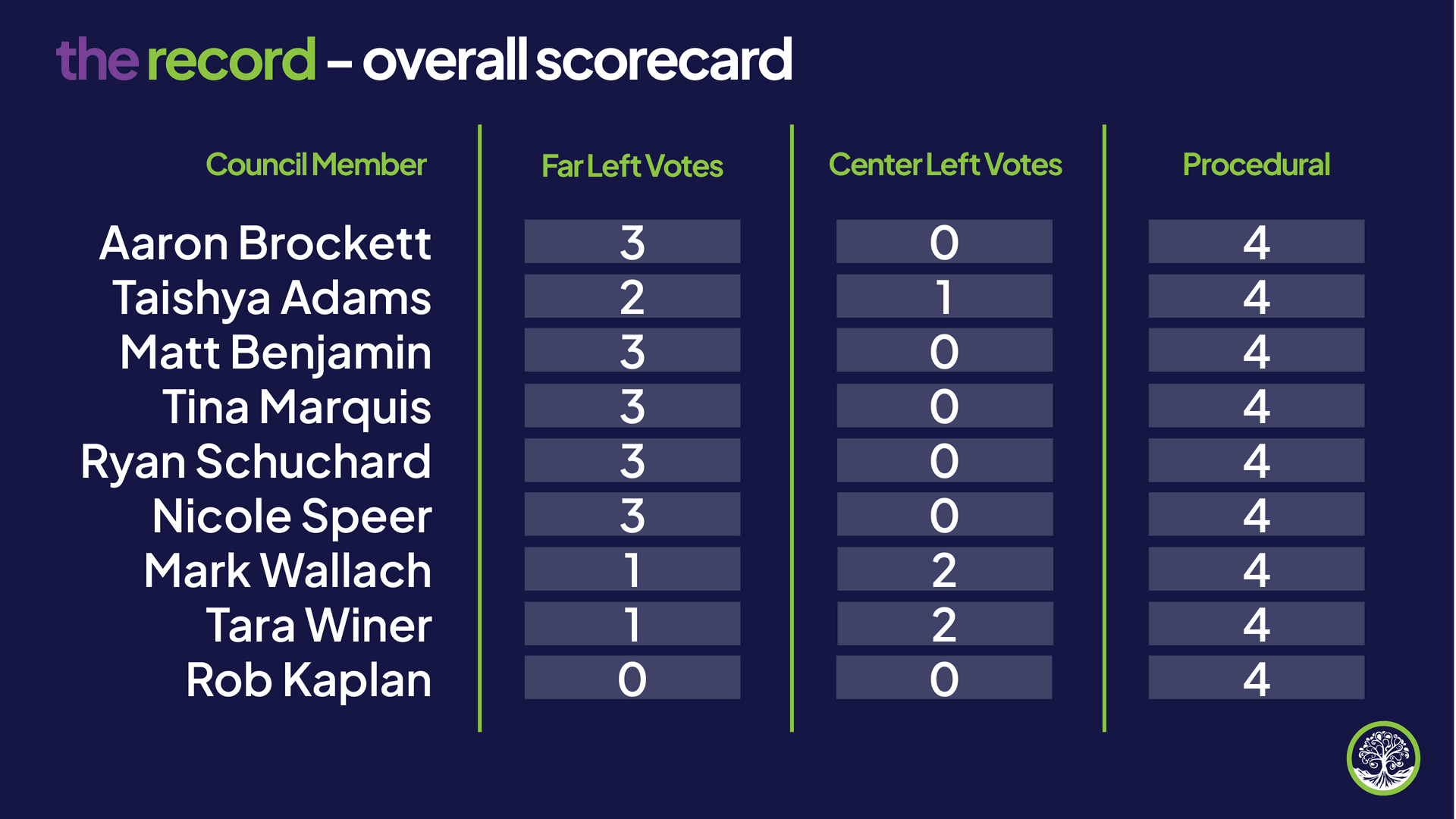
Public Hearing Votes - January 8, 2026
Outcome: Unanimous Approval on All Public Hearing Items
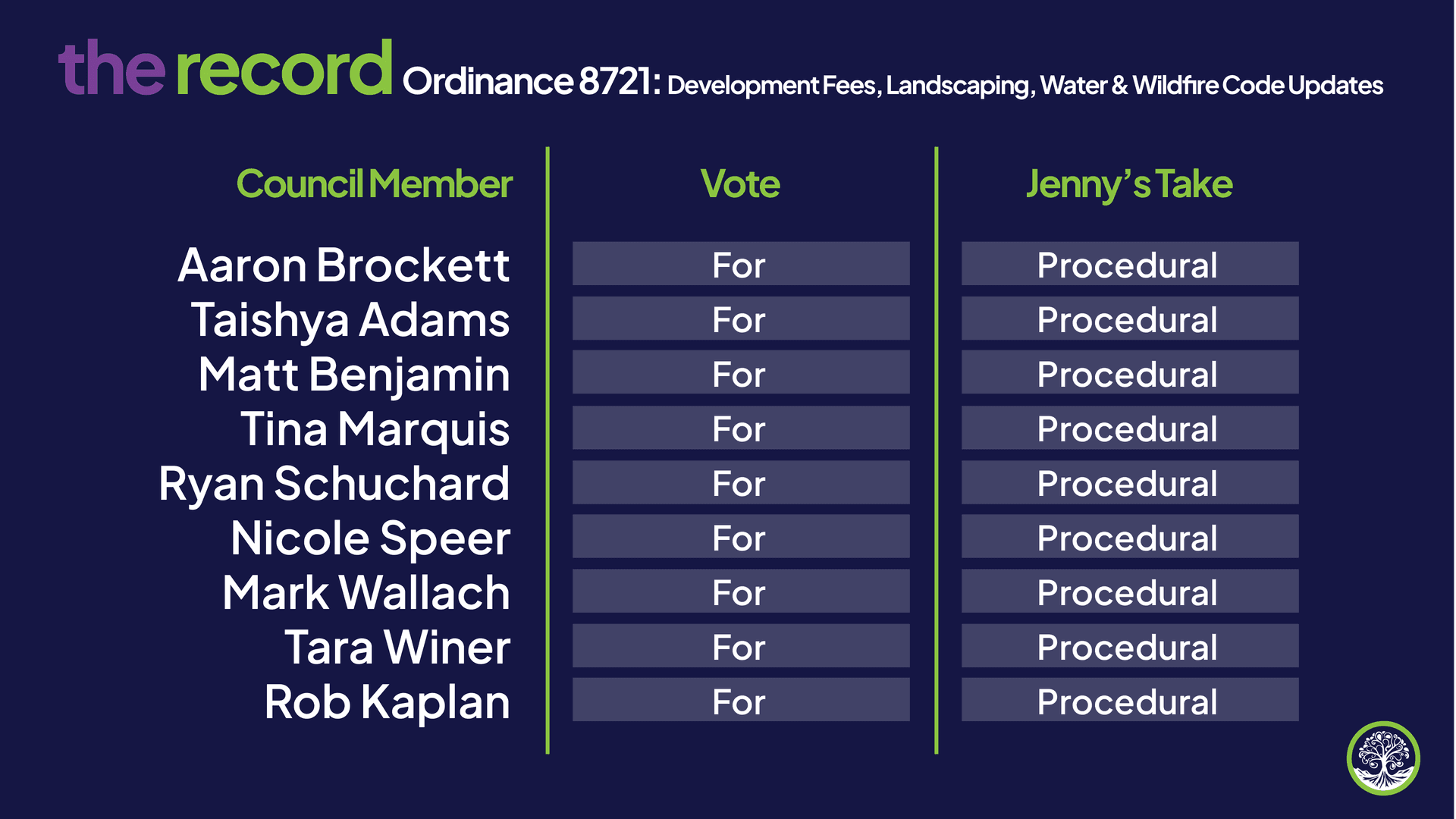
At its January 8, 2026 Special Meeting, the Boulder City Council unanimously approved all items that came forward as public hearings. While these votes were largely procedural, they included binding legal actions related to annexation, special district governance, and permanent changes to city code.
I am classifying all votes as “procedural” because they don’t reflect ideological direction or policy preference. These are staff driven actions Council is required to take to execute existing law, approve contracts, settle litigation, adopt technical code updates, or complete statutory processes like annexations and district budgets. In most cases, any council, progressive or moderate, would vote the same way. Since these votes don’t signal a governing philosophy, they are classified as procedural.
Why This Was a Special Meeting and Why Special Districts Matter
This meeting was designated a Special Meeting because Council needed to act in multiple legal roles, each governed by different state statutes and timelines:
- City Council (municipal legislative authority)
- Downtown Commercial District Board (a special improvement district)
- Knollwood Metropolitan District Board (a metropolitan district)
Special districts are independent governmental entities created under state law to finance or manage specific services or infrastructure (such as downtown improvements, utilities, or development-related costs). They can levy fees or taxes within their boundaries and operate separately from the city’s general fund even though City Council members often serve as the governing board.
If this sounds familiar, I covered how metro districts and special districts work in more detail in my last newsletter, which I encourage readers to revisit for a deeper dive.
The Record:
Council Approval of Annexation of 915 5th Street (LUR2024-00062)
Date of vote: January 8, 2025
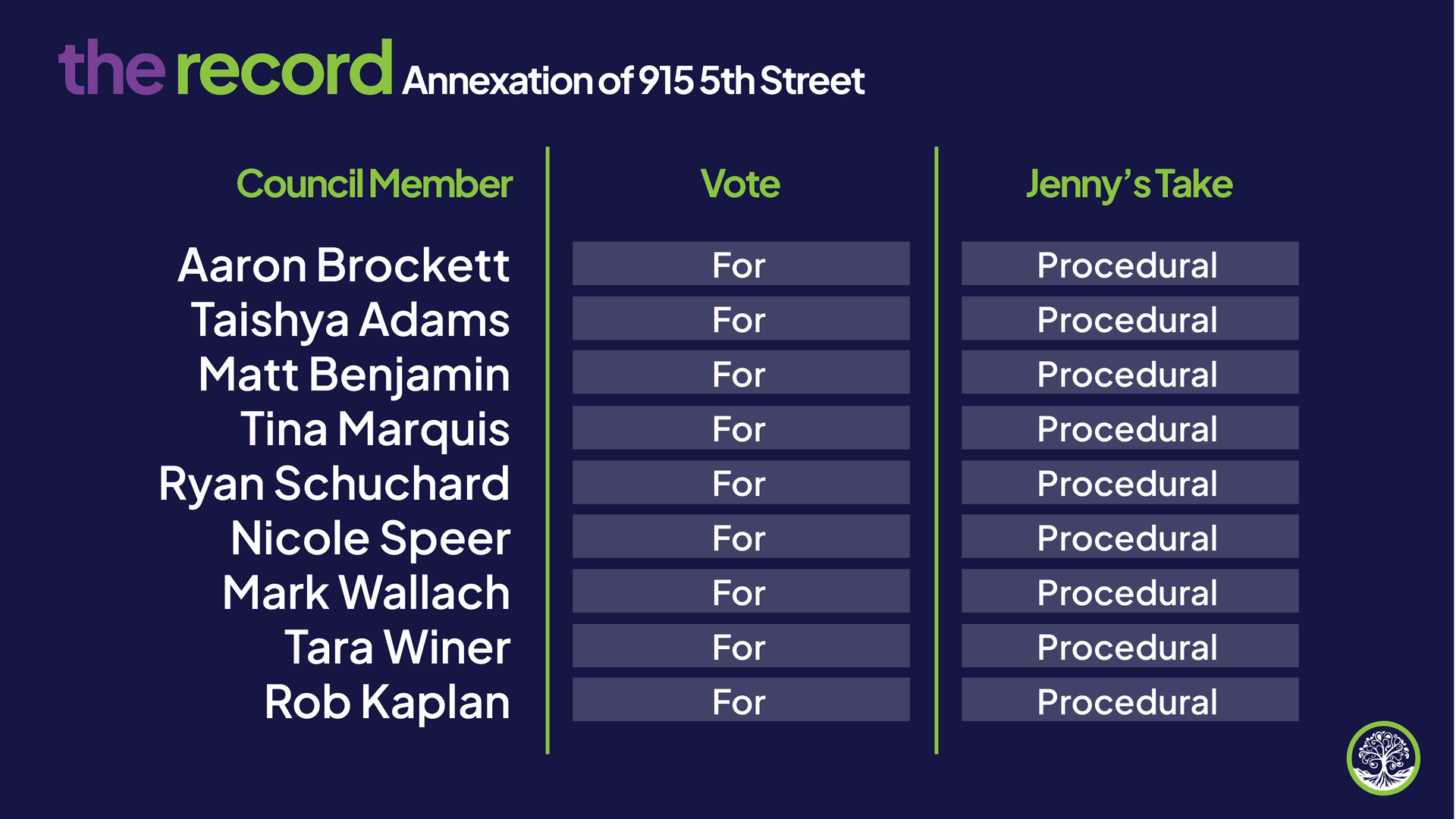
What Happened:
Council approved:
- Two Findings of Fact resolutions confirming the annexation met state statutory requirements
- Two final (second-reading) annexation ordinances, formally bringing the property into the City of Boulder
- A final ordinance consenting to inclusion in the Municipal Subdistrict of the Northern Colorado Water Conservancy District, enabling municipal water service
Why the city agreed to annex:
- Met state annexation criteria
- Was contiguous to the city
- Allowed the property to receive city water service, which cannot occur without annexation
- Applied a consistent Residential–Estate (RE) zoning designation, with no discretionary rezoning request
Property & Ownership: The packet identifies the applicant/owner as a private property owner. The site totals approximately 0.96 acres, annexed in two phases for technical compliance with state annexation law
Jenny’s take:
This was not a policy-driven upzoning or redevelopment decision, it was an annexation tied to service provision. Still, annexations quietly expand city boundaries and long-term service obligations, which is why they deserve transparency even when they’re uncontested.
Council Approved Knollwood Metropolitan District: 2025 Budget Appropriation
Date of vote: January 8, 2025
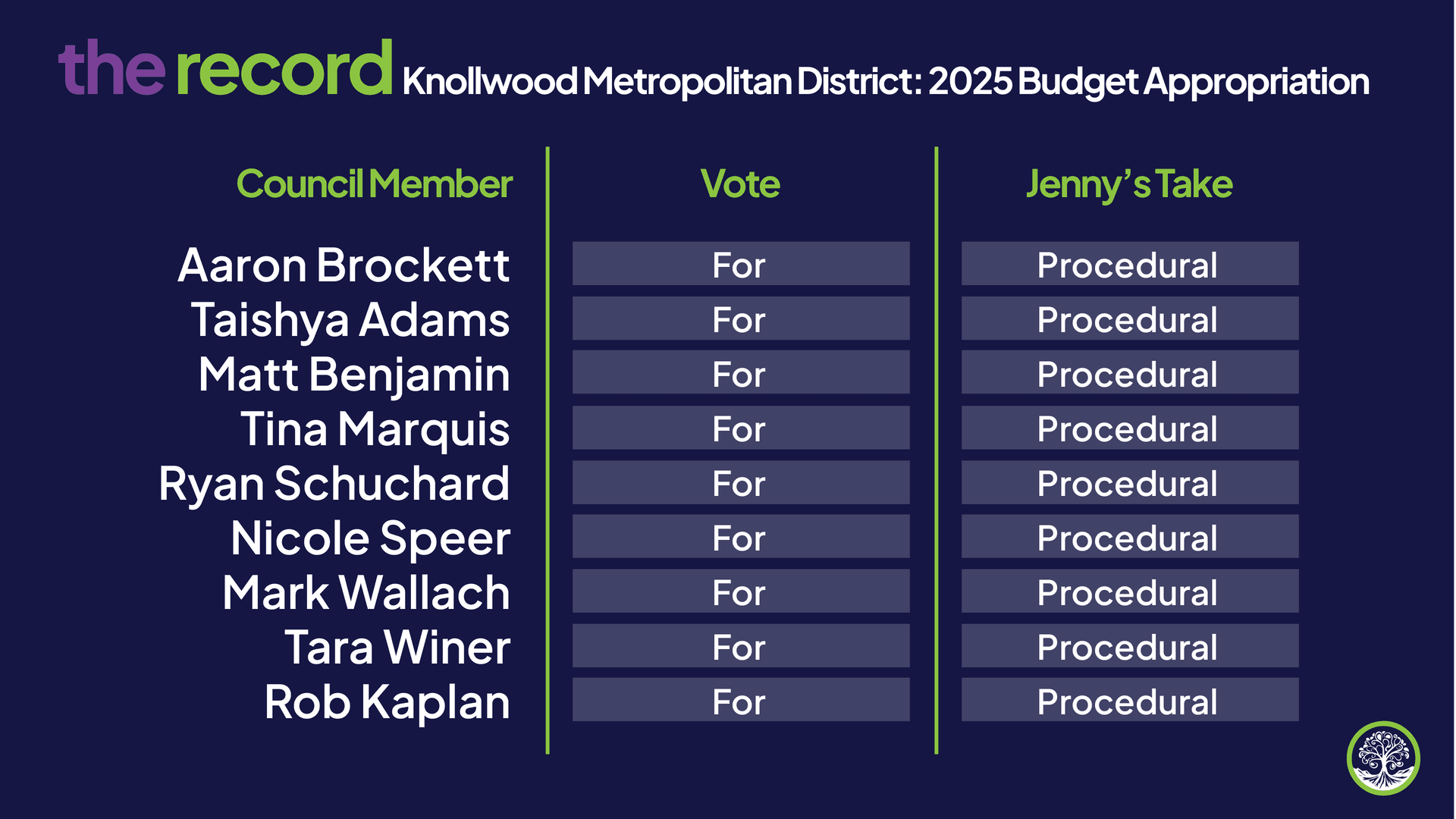
What Happened:
Council approved a resolution appropriating funds already within the district to pay existing operating expenses and liabilities for the 2025 fiscal year
What this does not do:
- Does not approve new debt
- Does not authorize new development
- Does not raise new taxes
Why this matters: Metro districts can collect revenue and incur obligations independently of the city’s general fund. Annual budget approvals are legally required and are one of the few times the public sees these entities on a council agenda.
Jenny’s take:
Metro districts aren’t inherently good or bad, but they are powerful. If you want a refresher on how they work and why oversight matters, see my last newsletter for a full explanation.
Council Approval of Ordinance 8721: Development Fees, Landscaping, Water & Wildfire Code Updates
Date of vote: January 8, 2025
What Happened:
This ordinance finalized a bundle of code amendments across multiple titles of the Boulder Revised Code.
Development Application Fees. What Changed:
The ordinance updates and aligns development application fees to better reflect:
- Actual staff review time, Technical complexity of applications, Updated cost recovery assumptions
- Adjustments to site review and use review fees
- Updates to building and planning-related application charges
- Changes intended to reduce subsidy from the general fund for private development review
These fees are paid by applicants, not taxpayers at large.
Practical Examples:
Landscaping & Water Standards
The ordinance strengthens requirements such as:
- Limits on high-water-use turf
- Increased use of low-water or native plant species
- Updated irrigation efficiency standards
- Clearer rules around landscape area calculations
These standards primarily affect new development and significant remodels, not routine home maintenance.
Wildland–Urban Interface (WUI) Code Provisions:
Updates to Boulder’s modified WUI Code include:
- Enhanced defensible space standards
- Vegetation management requirements near structures
- Fire-resistant material expectations in high-risk areas
- Alignment with updated wildfire risk mapping
These provisions are intended to reduce structural ignition risk in wildfire-prone areas. especially at the city’s edges.
Water Conservation & Service Requirements
The ordinance also updates:
- Requirements to avoid waste of water
- Maintenance obligations for service lines and fixtures
- Authority for enforcement when water systems are not properly maintained
In practice, this strengthens the city’s ability to require repairs or efficiency upgrades when water loss or misuse is identified.
Jenny’s take:
This ordinance is a reminder that many of Boulder’s biggest policy shifts happen through technical code changes, not sweeping resolutions. The goals are broadly supported, but the real test will be how these standards are implemented, especially for homeowners, small builders, and legacy properties.
Quick Recap: Non-Public-Hearing Votes
In addition to the public hearing items, the Boulder City Council approved several procedural and administrative actions that did not include formal public testimony.
- Xcel Energy letter
- Postponed. Council said they postponed the Xcel letter to review and strengthen it and residents pushed them in public comment to make it tougher. The meeting was dominated by the City’s presentation praising its own response to the windstorm and power shutoff. Voting that same night on a letter demanding accountability from Xcel would have most likely disrupted that narrative and reopened uncomfortable questions about what the City itself could have done better. We will need to watch this at the next meeting to be sure the city is holding Xcel accountable.
- Settlement agreement
- Approved a $91,332 settlement related to a 2025 water main break that damaged a private residence, avoiding litigation and additional legal costs
- Approved a $91,332 settlement related to a 2025 water main break that damaged a private residence, avoiding litigation and additional legal costs
- City fiber lease extension
- Approved a 20-year extension of an existing lease for use of four strands of city-owned dark fiber connecting several downtown municipal and commercial buildings, with modest rent adjustments and updated maintenance terms
- Approved a 20-year extension of an existing lease for use of four strands of city-owned dark fiber connecting several downtown municipal and commercial buildings, with modest rent adjustments and updated maintenance terms
- Sundance Institute agreement
- Approved a governing festival and city services agreement with the Sundance Institute, authorizing staff to finalize operational details tied to downtown use and city support
- Approved a governing festival and city services agreement with the Sundance Institute, authorizing staff to finalize operational details tied to downtown use and city support
- EV charger permitting policy
- Adopted a resolution affirming support for electric vehicle adoption while formally opting out of the state’s EV Charger Permitting Model Code, preserving local control over permitting standards
- Adopted a resolution affirming support for electric vehicle adoption while formally opting out of the state’s EV Charger Permitting Model Code, preserving local control over permitting standards
- Code housekeeping ordinance
- Adopted an emergency ordinance codifying previously approved ordinances and technical corrections into the Boulder Revised Code (no new policy changes)
- First-reading land use actions (no final approval yet)
- Introduced (first reading only):
- An annexation ordinance for property near Kewanee Drive / South Boulder Road
- Rezoning ordinances for 5501 and 5505 Arapahoe Avenue (BC-1 → MU-4)
- These items will return for public hearings and second readings before any final approval
- Introduced (first reading only):

Final Thought
This Special Meeting was about closing the loop on decisions already underway. Annexations, district governance, and code changes that now carry legal force.
Unanimous votes don’t mean low impact. They often mean consensus on steps that quietly shape the city for decades.
That’s why I keep a record.
-Jenny
Founder, Jenny on the Record