
Pedal-Cabs and Nods of Five


The Record:
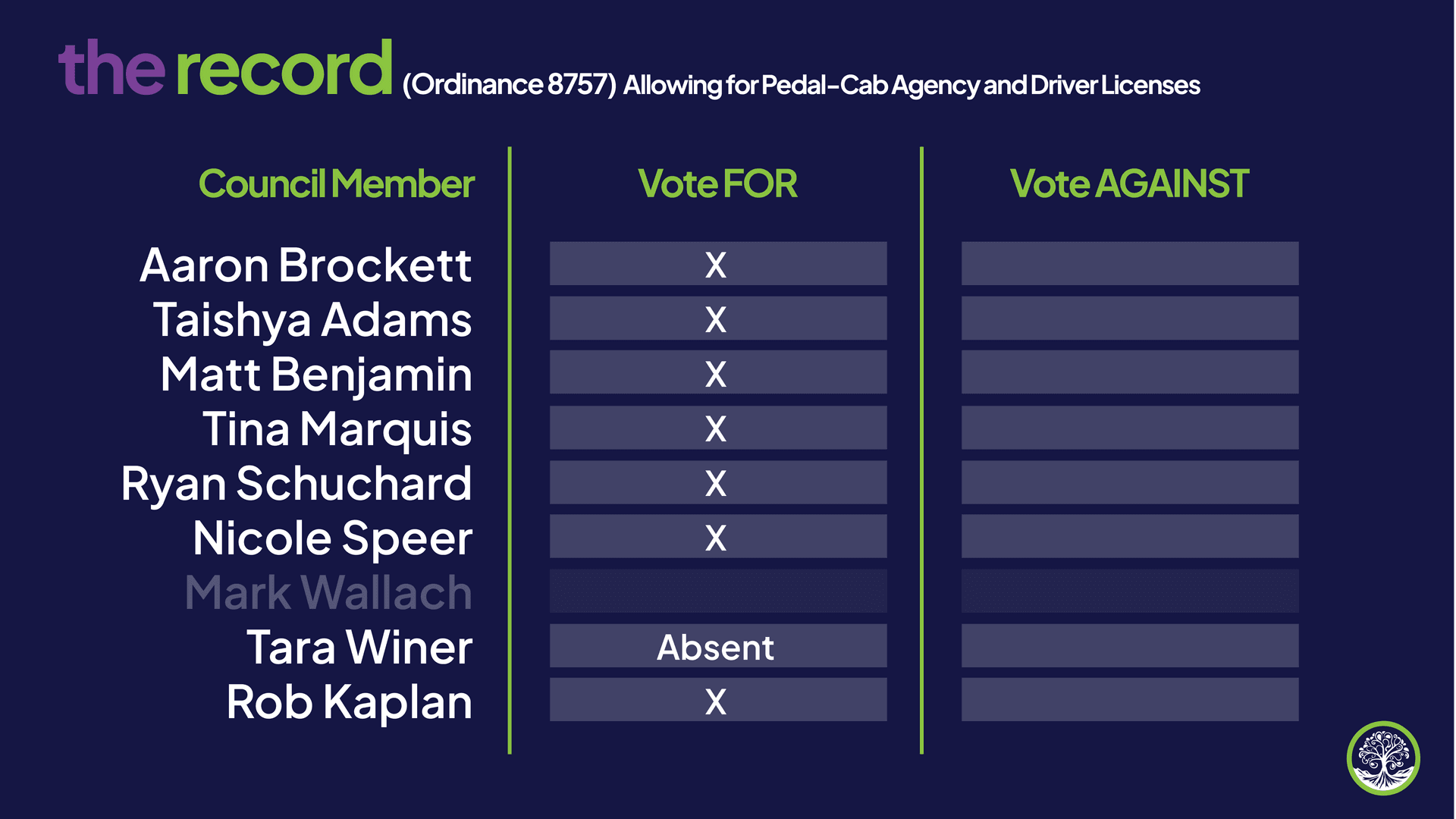
Public Hearing: Second reading and consideration of a motion to adopt Ordinance 8757 amending Title 4, “Licenses and Permits,” B.R.C. 1981, allowing for Pedal-Cab Agency and Driver Licenses
Date of vote: 9/3/2026
Outcome: Passed unanimously 7–0
Category: Procedural
What Happened
Council unanimously approved Ordinance 8757, creating a new licensing system for pedicab companies and drivers operating in Boulder. Staff said the change was prompted by an increase in pedicabs at large events and concerns about speeding, sidewalk obstruction and other safety issues. The new rules require companies to carry liability insurance and drivers to provide a valid license and driving record, undergo a background check and follow applicable bicycle laws. Pedicabs must also be human-powered, and operators cannot sell food, beverages or alcohol while operating.
The program is expected to generate about $3,300 annually in licensing fees, which staff says are intended to cover the cost of administering the program without adding new employees. Councilmember Matt Benjamin questioned whether Boulder should be careful about adding another cost for businesses, prompting a broader discussion about making sure licensing fees reflect the city's actual regulatory costs.
Why It Matters
The primary argument for the ordinance is public safety. Code Compliance Manager Jen Ross told Council that Boulder has seen an increase in pedicab-related traffic incidents as well as more pedicabs operating during large events.
Without a licensing system, the city hasn't had a reliable way to know who is operating, whether operators are properly insured or how to hold bad actors accountable. The new system changes that. Pedicab drivers will be required to carry their licenses while operating, Code Enforcement will be able to enforce licensing requirements, and Boulder Police will have an enforcement mechanism when operators violate bicycle traffic laws.
The city manager will also have the authority to deny, suspend or revoke licenses for violations or noncompliance. Staff clarified that CU regulates pedicabs on campus, while Boulder's ordinance applies within the city's jurisdiction.
Jenny's Take
If pedicabs are carrying passengers on Boulder streets, requiring insurance, basic driver qualifications and accountability makes sense. I also appreciated Matt Benjamin raising the bigger question: Are we charging businesses what it actually costs to regulate them, or simply adding another fee? In this case, the fees appear modest and tied to the cost of administering the program, but that's a question worth asking every time Boulder creates a new one.
NOD OF FIVE VOTES:
STATE-MANDATED LAND USE CHANGES
Council also received an update on three significant changes to Boulder’s Land Use Code that will be coming over the next two years, driven by recent state legislation and, in one case, the city's eligibility for state affordable-housing funding. Staff emphasized that the changes are not all optional, the state has increasingly stepped into areas traditionally controlled through local zoning, and Proposition 123 ties compliance to access to affordable-housing dollars.
The three areas are Proposition 123, Transit-Oriented Communities (HB24-1313), and the HOME Act. Proposition 123 will require Boulder to create a 90-day fast-track approval process for qualifying affordable-housing projects. To make that timeline possible, staff is recommending eliminating Planning Board call-ups and automatic public hearings for these projects, although an appeals process could still provide an avenue for a public hearing.
Staff warned that without these changes, Boulder and affordable-housing partners like Boulder Housing Partners, Thistle, and Habitat for Humanity could lose eligibility for Proposition 123 funding.
The second change involves the state's Transit-Oriented Communities law, which requires Boulder to demonstrate that its zoning allows a state-determined amount of housing near qualifying transit corridors. Depending on whether Boulder's existing zoning meets that calculation, additional density or zoning changes may be necessary.
The third is the HOME Act, which creates new requirements allowing qualifying entities such as certain nonprofits, governmental entities and educational institutions to develop housing on qualifying properties. Implementing it could require Boulder to change height limits, definitions, permitted uses and other development standards.
While this item was technically informational and no ordinance was adopted, Council was asked for direction on staff's proposed approach. Council gave unanimous nods of five on staff's recommendations for the first two items and a 6–2 (No-Tara Winer and Nicole Speer) nod on the final item. Because each received majority support, all three will move forward for staff to develop the necessary code changes and bring them back through the formal adoption process. Proposition 123 changes are expected first, with staff anticipating Council review in October; the transit-oriented changes are expected in 2027 if needed, and HOME Act changes in 2027 or early 2028.
Council did not actually change Boulder's zoning code Thursday night, but it did give staff the green light to begin drafting changes that could significantly alter how housing projects are reviewed, where housing can be built, and how much opportunity the public and Planning Board have to weigh in before certain projects are approved.
RESTAURANT TASK FORCE MOVES FORWARD
Council also gave a unanimous nod of five to move forward with the creation of a restaurant task force. The idea is to bring restaurant owners and other stakeholders together to take a broader look at the challenges facing Boulder’s restaurant industry and identify potential solutions. Given the recent conversations around the tip credit, rising operating costs, permitting and the overall health of Boulder’s restaurant community, this could provide an opportunity to look at the industry’s challenges more comprehensively rather than addressing them one issue at a time.
Boulder talks a lot about supporting local businesses, but our restaurants in particular are facing pressures from nearly every direction. A task force is only valuable if it ultimately leads to action, but getting the people who are actually operating these businesses at the table is a good place to start.
COUNTY COMMISSIONER BALLOT MEASURE
Mayor Aaron Brockett asked Council to add a discussion about the Boulder County ballot measure that would expand the Board of County Commissioners from three members to five, saying he wanted to see whether Council wished to take an official position.
Brockett said he personally supports the measure and argued that county government has a significant impact on both the city and Boulder residents. Several councilmembers questioned whether it was appropriate for the city to weigh in on another governing body's structure, particularly since the County Commissioners had not taken positions on changes to Boulder's own governance. Others argued that the County is such an important partner that the city has a legitimate interest in the issue. Council ultimately voted 5–3 (No - Ryan Schuchard, Nicole Speer, Matt Benjamin) to direct the city to take an official position in support of the ballot measure.
One interesting detail worth noting: support for the measure itself and support for the City taking a position weren't necessarily the same thing. Matt, for example, said he personally supports expanding the commission but didn't believe the City Council should officially weigh in. Nicole opposed both the City taking a position and the measure itself.
The Scorecard

Thank you for reading!
Jenny
Founder, Jenny on the Record