
The Election Is Over. Now Comes the Accountability.


Hi Boulder, it's been an eventful few weeks. Between the election, the adoption of the city's 2027 budget, and some important discussions at City Council, there is quite a bit to catch up on. Let's start with the election.
Election 2026: The Results and Some Reflections
The November 3rd election brought some familiar faces back to City Council, along with a few new ones.
Mayor Aaron Brockett won reelection, defeating Aquiles La Grave in the city's ranked-choice mayoral election. Incumbent Councilmembers Tara Winer, Tina Marquis, and Ryan Schuchard were reelected, while former Councilmember Jill Grano and former BVSD Board President Sam Fuqua won the remaining two seats.
The results further strengthened the Boulder Progressives' influence on City Council, with seven of the nine councilmembers having received endorsements from that organization.
On the ballot-measure side, voters delivered some interesting results.
The most significant was the defeat of Ballot Issue 2K, the $400 million Recreation and Safety Bond, with approximately 56% voting against it. Meanwhile, voters approved the residential vacancy tax (2J), the change to the city's debt-limit calculation (2M), and collective bargaining rights for full-time firefighters (2L).
At the county level, voters also approved expanding the Board of County Commissioners from three members to five, along with a new property tax for childcare. The Front Range Passenger Rail sales tax also passed.
While I respect the results of the election and congratulate those who won, I would be remiss if I didn't share my disappointment with the City of Boulder political environment that surrounded this campaign.
Once again, I watched what I believe were deeply troubling campaign tactics aimed at candidates perceived as threats to the Boulder Progressives' preferred slate. There is a significant difference between challenging a candidate's positions, examining their voting record, and engaging in personal attacks intended to undermine their character. Having experienced these tactics firsthand during my own campaigns, I find it discouraging that this style of politics continues to be accepted as part of Boulder's election process. We should be able to disagree about the future of our city without attempting to destroy the reputations of people willing to serve it.
I also worry about what this environment means for the future of local leadership. Running for office requires an enormous commitment of time, energy, and personal sacrifice. If qualified residents believe that simply entering a race will make them targets of personal attacks, why would they volunteer? That should concern all of us, regardless of our political affiliations.
Endorsements and Expectations
Several candidates received endorsements from organizations with significantly different and sometimes directly opposing political philosophies.
I find that interesting, and I believe it raises some legitimate questions. What commitments were made to earn those endorsements? Were candidates presenting the same positions to different groups? And, perhaps most importantly, can they realistically deliver on the expectations of organizations that fundamentally disagree on major city policies? To be clear, receiving endorsements from diverse groups can also be a positive sign of a candidate's willingness to work across political differences. But when those groups want very different outcomes, I think voters deserve to understand where a candidate ultimately stands.
This is precisely why I started Jenny on the Record. Campaign rhetoric is one thing. Governing is another. Elections are about more than winning. They are about what happens after the campaign signs come down, when promises must turn into policies and difficult votes.
I genuinely hope every incoming and returning councilmembers succeeds in making Boulder a better place. But support, endorsements, and campaign rhetoric should never replace accountability.
The Call for an Independent City Auditor
Many candidates expressed support for independent financial oversight and increased accountability at City Hall. That is why I was surprised by some of the resistance when Council discussed establishing an independent performance audit function at its November 12th meeting.
During that discussion, Councilmember Nicole Speer questioned what problem such an auditor would solve, while Councilmember Matt Benjamin raised concerns about creating a political "witch hunt."
I find the premise of those concerns difficult to understand given Boulder's current financial circumstances. We have recurring budget shortfalls, significant deferred maintenance, reductions in services, increasing costs to residents, and widespread concerns about spending priorities and financial transparency. Isn't that precisely the type of environment in which independent performance oversight could be valuable?
An independent auditor should not be about targeting staff, assigning blame, or pursuing political agendas. It should be about determining whether public dollars are being spent efficiently, whether programs are achieving measurable results, and whether the city is making responsible long-term financial decisions.
Ultimately, Council gave a 6–2 nod (Speer and Schuchard) to have staff research options for an independent performance audit function, with a report expected in the first quarter of 2027. That is an encouraging step, but it is not the same as establishing an auditor. I will be watching closely to see whether this campaign commitment becomes a reality. More details on this issue in the November 12th meeting section below.
And that brings us directly to the city's 2027 budget and all that has been happening at City Council.
October 15th City Council Meeting: The $552.6 Million Budget Is Approved
On October 15, City Council formally adopted Boulder's 2027 budget.
The numbers:
Total city budget: $552.6 million
Operating budget: $417.2 million
Capital budget: $135.4 million
Initially projected General Fund shortfall: $6.3 million
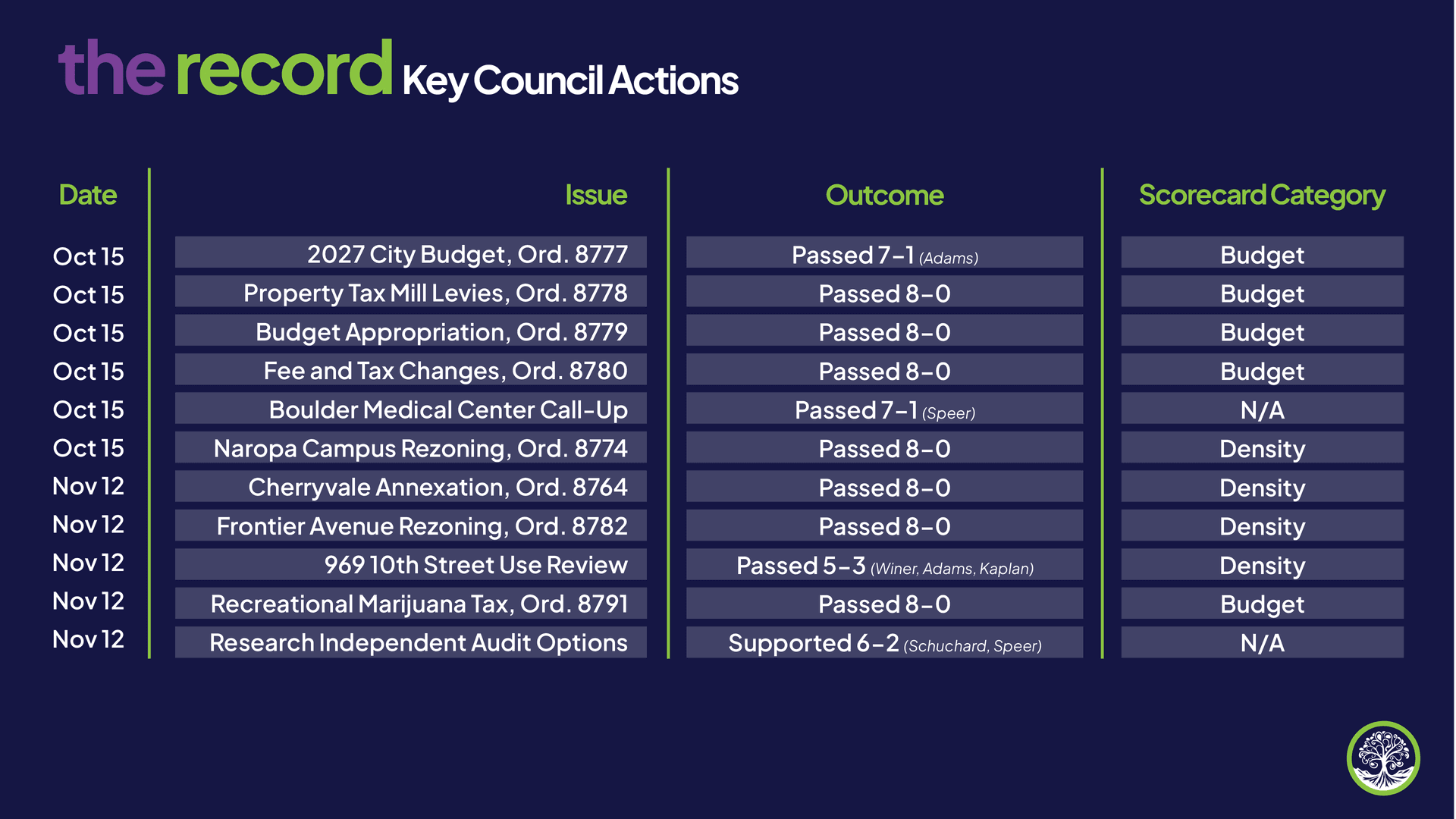
The budget was adopted on a 7–1 vote, with Councilmember Taishya Adams voting against it. The related property-tax levy, appropriation, and fee-and-tax ordinances passed unanimously.
The city deserves credit for closing its projected General Fund gap and presenting a balanced budget. But balancing a budget on paper and putting a city on a financially sustainable path are not necessarily the same thing. I have spent considerable time reviewing this budget through my role on the Parks and Recreation Advisory Board, and I remain concerned about the direction of our city's finances.
We are facing slower revenue growth, rising personnel and operating costs, increasing pressure on our infrastructure, and significant deferred maintenance across city facilities.
Personnel expenditures account for roughly 61% of the General Fund budget. Employee costs are increasing, utility expenses continue to rise, and city departments are being asked to absorb difficult reductions. At the same time, residents are seeing higher fees, reduced services, and aging public facilities.
At some point, we need to ask whether our spending priorities are aligned with our ability to maintain the basic services and infrastructure residents depend on.
I fully recognize that the city provides a wide range of important services and that budget decisions involve difficult trade-offs. But those trade-offs should be clearly communicated, measurable, and tied to outcomes.
Parks, Recreation, and Deferred Maintenance
One of my biggest concerns continues to be the condition of our recreation facilities and the lack of a sustainable funding strategy.
We have been discussing the substantial capital needs of our recreation centers for years. The South Boulder Recreation Center, East Boulder Recreation Center, and North Boulder Recreation Center all face significant maintenance and renovation needs. Meanwhile, access to aquatics continues to be an issue, and the future of Spruce Pool remains uncertain beyond 2027.
During the October 15th budget hearing, residents spoke in support of keeping Spruce Pool operating. The approved budget includes one-time funding to keep it open in 2027, but that does not solve its long-term financial challenges.
I also continue to have concerns about the budget review process itself. Advisory boards need adequate time, complete information, and a meaningful opportunity to evaluate financial proposals before recommendations reach City Council.
I did not support the proposed Parks and Recreation budget or Capital Improvement Program because I did not believe we had sufficiently addressed the long-term impacts on our facilities, services, and residents. That is not a criticism of our Parks and Recreation staff. They are being asked to make increasingly difficult decisions with limited resources. It is a concern about the larger financial framework and the priorities being established.
The Budget Process Needs to Change
Interestingly, several councilmembers also expressed frustration with the budget process during the October 15 meeting. Councilmember Matt Benjamin described the process as broken, and others raised concerns about the compressed timeline and the need for greater involvement from advisory boards.
I would like to see clearer performance metrics, stronger prioritization of core services, more transparent capital planning, and a willingness to evaluate programs based on measurable results. We should know not only where the money is going, but what taxpayers are receiving in return.
The $400 Million Bond: Voters Have Spoken
The budget discussion also takes on greater significance now that voters have rejected Ballot Issue 2K. The proposed bond would have authorized up to $400 million in borrowing for recreation and public safety facilities, with a maximum repayment amount of $650 million.
The city has very real facility needs. I have never questioned that. But I do question whether the city adequately demonstrated how these projects were prioritized, how the costs were established, and whether less expensive alternatives had been sufficiently evaluated. One particularly interesting development came at the October 15th meeting, when city staff presented an alternative approach for relocating the Police Department. Rather than constructing an entirely new facility, staff discussed the possibility of acquiring or leasing an existing office building and renovating it.
The preliminary analysis suggested this approach could save approximately $90 millioncompared with constructing a new building, while potentially reducing the project timeline.
To me, that is exactly the kind of analysis that should occur before voters are asked to authorize hundreds of millions of dollars in debt. Why weren't all of these alternatives more fully developed and presented before the bond was placed on the ballot?
The bond's failure does not mean residents don't care about recreation or public safety. I believe it reflects, at least in part, a desire for greater financial transparency, clearer priorities, and more confidence in how the city plans to spend substantial amounts of public money. The next step should not automatically be to return with another large bond. It should be to develop a credible, phased, financially responsible plan that residents can understand and evaluate.
Other October 15th Council Actions:
Boulder Medical Center Redevelopment- Call Up Approved, 7–1 (Speer)
Council voted to call up a proposed redevelopment of the Boulder Medical Center properties at 2750 Broadway and nearby Balsam Avenue parcels. The concept includes approximately 223 housing units across three buildings, with a rezoning and height modification required for portions of the project. Residents raised concerns about building scale, traffic, neighborhood compatibility, and emergency evacuation.
I believe these are exactly the types of issues that deserve careful Council review, particularly as Boulder begins implementing changes associated with the updated Boulder Valley Comprehensive Plan. The call-up does not mean the development has been approved or denied. It means Council will have an opportunity to review the proposal more closely.
Naropa Campus Rezoning- Approved, 8–0
Council unanimously approved rezoning approximately 3.72 acres at 2106 and 2130 Arapahoe Avenue from Public zoning to Residential–High 5. The change supports a proposed student-housing redevelopment of the property.
November 12th City Council Meeting: Development, Taxes, and Accountability
The November 12 special meeting included several land-use decisions, an increase to the recreational marijuana sales tax, and a discussion that I believe could become one of the most important governance conversations of the coming year.
An Independent City Auditor: Why Is This So Controversial? Nod, 6-2
Councilmember Rob Kaplan brought forward a request to explore establishing an independent performance audit function for the City of Boulder. His proposal was relatively straightforward: direct staff to research the different models available, their costs, and any implications for the city charter, and bring that information back to Council in the first quarter of 2027.
This was not a proposal to immediately create a new position or department. It was simply a request to research the options. Council ultimately supported moving forward with that research by a 6–2 show of hands (Speer and Schuchard).
An independent auditor is not an accusation of wrongdoing. It is a tool for good governance. We are talking about a city with a budget exceeding half a billion dollars, substantial capital obligations, aging infrastructure, and increasing financial pressure.
Why wouldn't we want an independent assessment of how effectively our resources are being used? An independent performance auditor can evaluate whether programs are achieving their intended outcomes, whether operations are efficient, whether major projects are being managed effectively, and whether public dollars are being used responsibly. That is different from a traditional financial audit, which generally focuses on whether financial statements are accurate and comply with applicable standards.
Both serve important purposes. Councilmember Kaplan made a compelling point: Council adopts budgets and establishes policy, but it depends heavily on information provided by the organization it oversees. That is not a criticism of city staff. It is simply a structural reality. Independent review can provide a different perspective, identify opportunities for improvement, and help build public confidence.
And frankly, after an election in which fiscal responsibility and city spending were major topics of discussion, I find it difficult to understand why even researching an independent audit function would meet resistance. If the concern is cost, let's evaluate the cost. If the concern is scope, let's define the scope. If the concern is whether the position would actually produce meaningful results, let's examine how comparable cities have structured and used these functions. But shouldn't we gather the information before deciding that an independent auditor is unnecessary?
I was pleased that a majority of Council supported the initial research, but the real test will come when that information returns in early 2027 and Council must decide whether it is willing to establish a genuinely independent oversight mechanism.
Pearl Arts District Rezoning - Approved, 8–0
Council unanimously approved Ordinance 8782, rezoning approximately 14.84 acres at 3550 and 3850 Frontier Avenue from industrial classifications to Mixed-Use 4. The proposed Pearl Arts District development includes a performing arts venue, residential housing, hotel space, and complementary commercial uses.
The plans discussed include a venue with capacity for approximately 2,500 people, roughly 500 residential units, and a hotel. The project has the potential to become an important addition to Boulder's arts and cultural landscape and to contribute to local economic activity.
I am encouraged by projects that create opportunities to strengthen Boulder's cultural identity and economic vitality. However, as always, the details of implementation matter, particularly transportation, infrastructure capacity, and the financial feasibility of the proposed uses.
University Hill Duplex Expansion - Approved, 5–3
Council also considered a nonconforming use review for a duplex at 969 10th Street.
The application proposed converting existing attic space into habitable space and adding one bedroom to each unit, without expanding the building's exterior. The proposal passed, with Councilmembers Taishya Adams, Tara Winer and Rob Kaplan voting against it. The discussion reflected ongoing tensions between property rights, housing needs, neighborhood compatibility, and quality-of-life concerns on University Hill.
Several councilmembers acknowledged the broader need to address regulations and enforcement issues on the Hill, even where an individual application meets existing review criteria. This is an area where I would like to see clearer and more consistent policy rather than repeated case-by-case uncertainty.
Cherryvale Road Annexation - Approved, 8–0
Council unanimously approved the annexation of approximately 5.43 acres at 1275 Cherryvale Road and 5995 McSorley Lane. The approval included changing the Boulder Valley Comprehensive Plan land-use designation from Rural Lands to Neighborhood 1 and establishing an initial Residential–Rural 2 zoning designation.
Recreational Marijuana Sales Tax Increase - Approved, 8–0
Council adopted Emergency Ordinance 8791, increasing the city's additional recreational marijuana sales and use tax from 3.5% to 5.5%.
Staff explained that the increase had already been incorporated into the 2027 budget and that the emergency adoption was necessary to meet state notification requirements for a January 1 implementation. Although this is a specific tax rather than a general sales-tax increase, it is another example of the city relying on increased revenues as part of its financial strategy.
I continue to believe that revenue increases should be accompanied by careful scrutiny of existing expenditures and clear explanations of how additional funds will improve services.
Looking Ahead: What Should We Be Watching?
The election is behind us, but several significant issues remain unresolved. Boulder must determine how it will address its aging recreation and public safety facilities without the proposed $400 million bond.
Council will continue evaluating development proposals under the updated Boulder Valley Comprehensive Plan. The city will need to confront its long-term financial challenges, including personnel costs, declining or slowing revenue growth, deferred maintenance, and the difficult choices associated with sustaining core services.
And in early 2027, Council should receive information about establishing an independent performance audit function. For me, these discussions are all connected. They ultimately come down to the same fundamental questions:
Are we spending public money responsibly? Are we prioritizing the services residents need most? Are we measuring results? And are elected officials willing to ask difficult questions and challenge established practices when necessary?
I also intend to continue tracking the commitments made by newly elected and returning councilmembers. Endorsements are one thing. Actual votes are another. Candidates may campaign on fiscal responsibility, transparency, affordability, public safety, or housing solutions, but the real record is established when they are faced with decisions that involve competing priorities.
That is where campaign promises become meaningful, or don't.
Jenny’s Take
I started Jenny on the Record because I believe residents deserve an accessible way to understand what is happening at City Council, how decisions are made, and how their elected officials vote. I also believe it is possible to care deeply about Boulder while disagreeing with the direction of some of its policies.
We should be able to celebrate the good things happening in our community while openly questioning decisions that may not be in its best interest. And we should be able to hold elected officials accountable without making those disagreements personal.
As we move into a new Council term, I hope we can find a way to elevate the conversation, encourage broader participation, and focus more on results than political affiliations. The election may be over, but the responsibility to govern and the responsibility to hold our government accountable, is just beginning.
Thank you for reading!
Jenny
Founder, Jenny on the Record